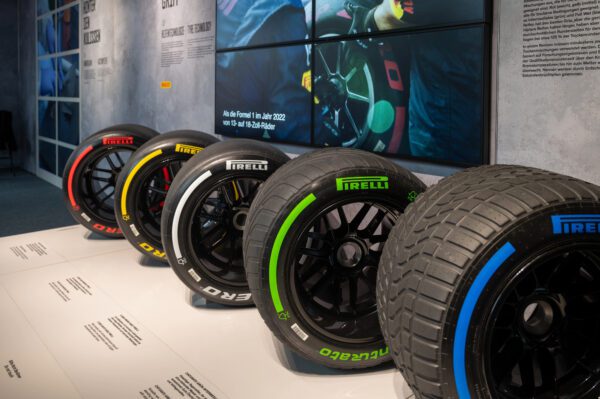





Formula 1 cars are precisely engineered machines, with their dimensions strictly governed by the Fédération Internationale de l’Automobile (FIA) technical regulations. These regulations dictate various aspects of the car’s size, influencing its performance and design.
While there is no explicit maximum overall length, other rules indirectly limit the total dimensions of the vehicles.
The current generation of Formula 1 cars, as seen in the 2025 season, adheres to specific maximums for width and height. These measurements are crucial for maintaining a level playing field and ensuring driver safety across all competing teams.
Formula 1 car dimensions in 2025
As of the 2025 Formula 1 season, cars are designed to a maximum width of 2.0 meters (200 cm). The maximum height permitted for these vehicles is 0.95 meters (95 cm).
While no specific maximum length is mandated, cars typically measure around 5.63 meters (18.5 feet) in overall length.
The wheelbase, which is the distance between the front and rear axles, for modern F1 cars in 2025 is approximately 3.6 meters (3600 mm). Some teams may push this measurement slightly, with wheelbases stretching towards 3.7 or 3.8 meters depending on their design philosophy.
The minimum weight for a Formula 1 car, including the driver and fitted with dry-weather tyres but without fuel, is 800 kg for the 2025 season.
Key measurements and specifications
Beyond the primary length, width, and height, several other dimensions and specifications are critical to a Formula 1 car’s overall size and performance. The wheel rim diameter, standardized since 2022, is 18 inches.

This change from the previous 13-inch wheels significantly impacted car design and handling.
Tyre dimensions also play a significant role in the car’s footprint. For the current era, front tyres have a width of 305mm, while rear tyres are wider at 405mm.
The overall diameter of the tyres increased from 670mm to 720mm with the introduction of 18-inch wheels in 2022.
| Dimension | 2025 Regulations | 2026 Regulations |
|---|---|---|
| Maximum Overall Length | ~5.63 meters (18.5 feet) | ~5.4 meters (anticipated) |
| Maximum Width | 2.0 meters (200 cm) | 1.9 meters (190 cm) |
| Maximum Height | 0.95 meters (95 cm) | 0.95 meters (95 cm) |
| Wheelbase | ~3.6 meters (3600 mm) | 3.4 meters (3400 mm) |
| Minimum Weight (with driver, dry tyres, no fuel) | 800 kg | 768 kg |
| Front Tyre Width | 305 mm | 275 mm |
| Rear Tyre Width | 405 mm | 375 mm |
| Wheel Rim Diameter | 18 inches | 18 inches |
The evolution of F1 car size
Formula 1 cars have undergone significant dimensional changes throughout the sport’s history. In 1991, a Ferrari F1 car measured approximately 4.4 meters in length and weighed around 500 kg.
By 1993, cars like the McLaren MP4/8 were about 174 inches (approximately 4.42 meters) long.
A notable shift occurred in 1994 when the maximum permitted width of cars was reduced to 2.0 meters (2000 mm). However, the trend reversed in 2017, with the overall width increasing from 1.8 meters back to 2.0 meters to accommodate larger Pirelli tyres, which grew by about 25 percent in size.
Over the past three decades, F1 cars have almost doubled in size, with modern cars approaching 5.6 meters in length and 800 kg in weight.
Anticipated changes for 2026 regulations
The 2026 Formula 1 technical regulations introduce substantial changes aimed at making cars more agile and promoting closer racing. The maximum wheelbase will be reduced by 200mm, shrinking to 3.4 meters (3400 mm).
The overall width of the cars will also be cut by 100mm, resulting in a new maximum of 1.9 meters (1900 mm).
Furthermore, the floor width will be reduced by 100mm or 150mm, contributing to the overall smaller footprint. The minimum weight of the cars will decrease by 32 kg compared to 2025, settling at 768 kg.
This weight reduction includes an estimated 722 kg for the car and 46 kg for the tyres.
Tyre dimensions will also be adjusted for 2026, with the 18-inch wheel size remaining. However, the front tyres will be 25mm narrower, and the rear tyres will be 30mm narrower.
These changes are designed to reduce drag and save weight, with a minimal expected loss of grip.
Impact on design and performance
The dimensions of a Formula 1 car significantly influence its aerodynamic performance, handling characteristics, and overall speed. Longer wheelbases, prevalent in recent years, generally offer greater stability and allow for more effective aerodynamic packaging, which can generate substantial downforce.
However, this increased length can compromise a car’s nimbleness, making it more challenging to navigate tight corners and potentially hindering overtaking opportunities.
The upcoming 2026 regulations, with their focus on smaller and lighter cars, aim to address these performance trade-offs. The reduced dimensions, combined with new active aerodynamic systems featuring movable front and rear wings, are intended to create more agile cars.
These active aero elements will allow cars to switch between a low-drag ‘Straight Mode’ for higher top speeds and a ‘Corner Mode’ for increased downforce and grip. The overall reduction in downforce by 30% and drag by 55% is expected to improve efficiency and make cars more raceable.