



Formula 1 pit stops are a highly choreographed operation where teams service a car, primarily changing all four tires, often in under two seconds. This rapid process is a critical element of race strategy and performance, involving approximately 20 mechanics working in perfect synchronisation.
Beyond tire changes, pit stops can also involve minor repairs or adjustments to the front and rear wings, though refueling has been banned since 2010.
The mechanics of a Formula 1 pit stop
A Formula 1 pit stop begins with the driver entering the pit lane, adhering to a strict speed limit, typically 80 km/h, which can vary by circuit. The pit crew is already in position, ready for the car’s arrival.
As the car stops in its designated pit box, jack operators quickly lift the front and rear of the vehicle. Simultaneously, wheel gunners use pneumatic guns to remove the single central wheel nut on each tire.
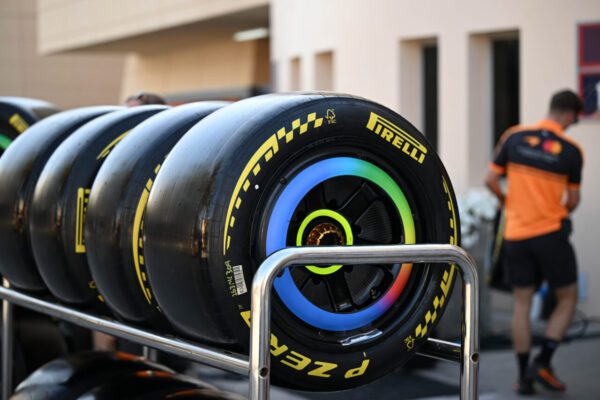
Other mechanics are responsible for pulling off the old tires and fitting the new ones, ensuring the correct compound is installed on all four corners. The entire sequence is rehearsed hundreds of times to achieve maximum efficiency.
Once all tires are securely fitted and the wheel gunners confirm this, the car is released back into the pit lane, provided the pit exit light is green. An unsafe release, where a car is sent out in a dangerous condition or into the path of another competitor, is a serious offense.
Mandatory pit stops and strategic flexibility
In a dry Formula 1 race, a pit stop is compulsory because drivers are required to use at least two different dry tire compounds. This regulation effectively mandates at least one stop during the Grand Prix.
However, if a race is declared wet and intermediate or full wet tires are used, the rule requiring two different dry compounds no longer applies. In such conditions, a driver could theoretically complete the entire race without making a pit stop.


There is no maximum limit to the number of pit stops a team can make during a race. Teams often make strategic decisions to pit multiple times based on tire degradation, track conditions, or safety car periods.
A significant strategic element is the “free” pit stop offered under red flag conditions. If a race is red-flagged, teams are permitted to change tires while the cars are stopped in the pit lane, and this change counts towards the mandatory two-compound rule without costing track time.
For the 2025 Monaco Grand Prix, a mandatory two-stop strategy was trialed to enhance the sporting spectacle, requiring drivers to use at least three sets of tires. However, this specific rule was removed for the 2026 season, reverting Monaco to the standard one-stop requirement.
Discussions within the F1 Commission in late 2025 explored proposals for mandatory two-stop races or requiring the use of all three nominated compounds for Grands Prix in 2026. No changes were agreed upon at that time, with talks expected to continue after the initial races of the 2026 season.
The evolution of pit stop timing and safety
Modern Formula 1 pit stops are remarkably fast, with the current world record standing at 1.80 seconds, achieved by McLaren at the 2023 Qatar Grand Prix. Competitive stops typically fall within the two to three-second range.
The speed of pit stops dramatically increased after refueling was banned from races in 2010, allowing teams to focus solely on tire changes and minor adjustments. Before this ban, pit stops could last six to twelve seconds, depending on the fuel load.
While there is no official minimum pit stop time, the FIA introduced safety measures in 2022 following the introduction of larger 18-inch wheels. These measures aimed to prevent premature car releases.
Initial proposals included specific delays between tire securing sensors and software responses, and between wheel gun button presses and the green light. However, due to team feedback, these exact delays were not implemented.
Instead, teams are now required to ensure the car is safely released and must share pit stop data with the FIA to confirm compliance. A pit stop under green flag conditions typically costs a driver approximately 22 seconds of race time.
Formula 1 tire regulations in 2026
Pirelli continues as the sole tire supplier for Formula 1, with their contract extended until at least 2028. The 2026 season introduces several changes to tire specifications to align with new car regulations.
While the 18-inch wheel rims remain, the tires themselves are narrower than in previous seasons. The front tires are 25mm less in width, and the rear tires are 30mm less.
The overall outer diameter of the tires has also been reduced, dropping from 720mm to between 705mm and 710mm. These changes are part of a broader effort to make the 2026 cars lighter and more agile, with reduced downforce and drag.
Tire compounds and race strategy
For the 2026 season, Pirelli provides five slick (dry weather) tire compounds, ranging from C1, the hardest and most durable, to C5, the softest and grippiest. The C6 compound, which was part of the 2025 range, was removed for 2026 due to an insufficient performance difference from the C5.
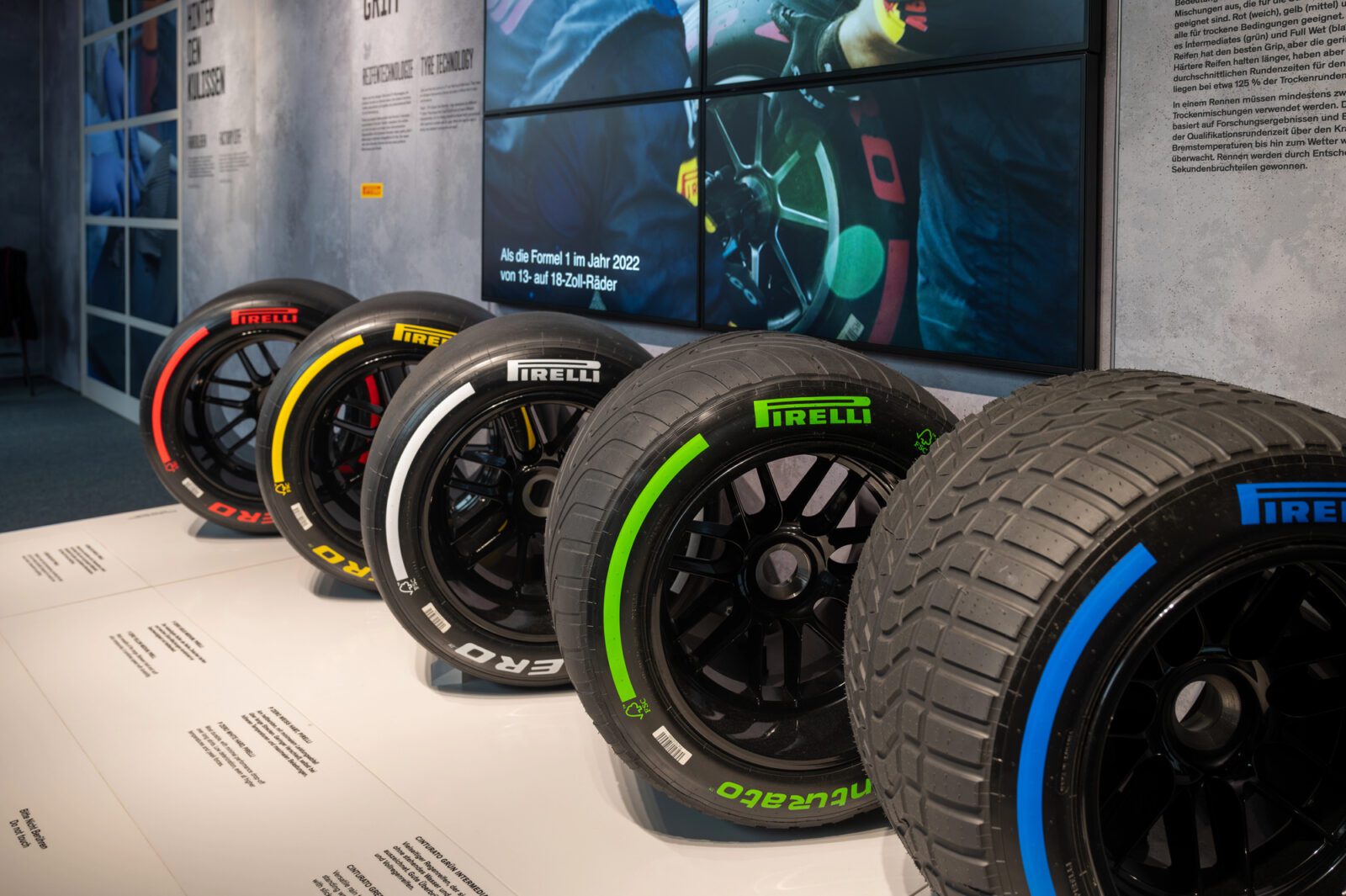
In addition to the slick tires, Pirelli supplies two types of wet-weather tires: intermediates, identified by a green sidewall, for damp conditions, and full wets, with a blue sidewall, for heavy standing water.
For each Grand Prix, Pirelli nominates three of the five slick compounds, designating them as Hard (white sidewall), Medium (yellow sidewall), and Soft (red sidewall). The specific C-numbers corresponding to these colors vary depending on the track characteristics and expected conditions.
Teams receive a specific allocation of tires for each race weekend. For a standard Grand Prix weekend, each driver is allocated 13 sets of dry tires (2 hard, 3 medium, 8 soft), 4 sets of intermediates, and 3 sets of full wets.
During a dry race, drivers must use at least two different dry tire compounds, with at least one being a mandatory race specification chosen by the FIA. All four tires on a car must be of the same compound.
| Tire Type | Compound Range (2026) | Sidewall Color | Characteristics |
|---|---|---|---|
| Slick (Dry) | C1 (Hardest) to C5 (Softest) | White (Hard), Yellow (Medium), Red (Soft) | C1 offers least grip, most durability; C5 offers maximum grip, least durability. Three chosen per race. |
| Intermediate | N/A | Green | For damp tracks with light standing water. |
| Full Wet | N/A | Blue | For heavy standing water and significant rain. |