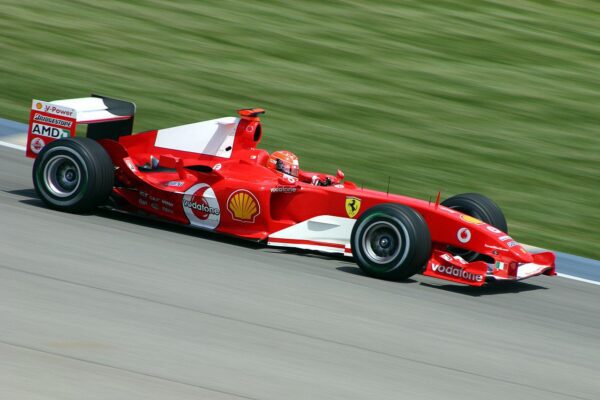





Formula 1 cars generate significant noise levels, a characteristic that has evolved considerably over the sport’s history. While modern turbo-hybrid engines are notably quieter than their predecessors, they still produce sounds well above the human pain threshold.
Drivers rely on sophisticated hearing protection to manage these intense acoustic environments during races.
The raw noise inside an F1 cockpit, without any protection, can exceed 120 decibels at speeds of 200 mph, a level capable of causing permanent hearing damage within minutes. This hostile environment is a combination of the turbocharged V6 engine, electrical motor generator units, and the gearbox.
Additionally, significant wind noise contributes to the overall sound pressure experienced by the driver.
The evolution of Formula 1 engine noise
The sound of Formula 1 cars has undergone a dramatic transformation, particularly with the introduction of the V6 turbo-hybrid power units in 2014. Prior to this change, the naturally aspirated engines were renowned for their deafening roar and high-pitched screams.
The V8 era, which concluded in 2013, saw cars producing approximately 145 decibels. Even louder were the V10 engines of the 2000s, which measured close to 140 decibels, while the V12 engines of earlier decades could exceed 150 decibels.
These older engines were so loud that some circuits faced noise limitations, putting their ability to host races at risk.
The shift to the V6 turbo-hybrid engines in 2014 resulted in a significant reduction in noise. Modern F1 cars typically measure around 134 decibels, though they can still reach close to 130 decibels at full speed.


An 11-decibel drop, such as that from the V8 to the V6 turbo-hybrid era, represents a substantial change in sound intensity. Decibels are logarithmic, meaning a 10 dB step signifies a tenfold change in sound intensity and roughly a halving of perceived loudness.
Therefore, the V8 engines were emitting over ten times the sound energy and sounded approximately twice as loud as the current cars. The primary reasons for this reduction include the turbocharger, which acts as a muffler by absorbing acoustic energy in the exhaust stream.
Furthermore, fewer cylinders and lower engine revolutions per minute (RPM) contribute to a lower pitch and overall quieter sound. The energy recovery system also plays a role by recovering energy that was previously dissipated as heat and sound.
| Engine Era | Approximate Decibel Level (Trackside) | Key Characteristics |
|---|---|---|
| V12 Engines (Pre-1990s) | >150 dB | Extremely loud, high-revving, often faced noise restrictions. |
| V10 Engines (1990s-2005) | ~140 dB | Screaming, high-pitched, iconic sound. |
| V8 Engines (2006-2013) | ~145 dB | Loud, high-revving, distinct roar. |
| V6 Turbo-Hybrid (2014-Present) | ~130-134 dB | Quieter, lower pitch, whistling sound from turbocharger. |
Understanding decibel levels and hearing risk
The human ear is highly susceptible to damage from prolonged exposure to loud noises. A safe decibel level, unlikely to cause permanent hearing damage, is generally considered to be around 75 decibels.
The threshold at which sound becomes physically painful for humans is approximately 130 decibels. Given that modern F1 cars operate at or above this level, ear protection is not merely a preference but a necessity for anyone at a circuit.
Exposure to 85 decibels can cause hearing damage if prolonged, while at 140 decibels, permanent hearing damage can occur within seconds. This highlights the extreme risk posed by unprotected exposure to F1 car noise.
For comparison, a loud thunderclap is around 120 decibels, fireworks can reach up to 150 decibels, and a gunshot is typically between 150-170 decibels. Standing near a turbine engine on a modern jet aircraft produces a similar sound intensity to older F1 cars, around 140 decibels.
Inside the cockpit: a driver’s acoustic environment
Despite the overall reduction in external noise, the environment inside an F1 cockpit remains incredibly loud. Drivers are positioned mere inches from the engine, gearbox, and other mechanical components, amplifying the direct sound.
Without protection, the noise levels inside the cockpit would exceed 120 decibels, potentially reaching 140 decibels. This level of noise would not only be painful but would also quickly lead to irreversible hearing damage.
Beyond the engine, significant aerodynamic noise is generated by the air flowing over the car and the driver’s helmet. This wind noise alone could cause a severe headache after just a single lap.
The combination of mechanical and aerodynamic noise creates a challenging sensory environment. Drivers must manage this while maintaining peak concentration and processing vital information from their team.
Advanced hearing protection for Formula 1 drivers
Formula 1 drivers utilize highly specialized hearing protection to mitigate the extreme noise levels. This typically involves custom-molded earplugs worn underneath their carbon fiber helmets.
These earplugs are not simple noise blockers; they are designed with special filters. These filters reduce damaging frequencies while allowing crucial sounds, such as radio communications from the team, to remain clear.
The combination of the helmet and these advanced earpieces provides a substantial noise reduction of 30 to 40 decibels. This brings the sound level inside the driver’s ear down to a more manageable range of roughly 80 to 90 decibels.
This calibrated level of noise reduction is critical for driver performance. If too much sound were blocked, drivers would lose vital sensory input, such as the audible pitch of the engine’s RPM, which they use to time gearshifts without looking at their steering wheel display.
Some earplugs even integrate built-in speakers for direct team communication, ensuring clear and uninterrupted dialogue. Companies like Loop have partnered with teams such as McLaren to provide advanced ear protection with adjustable sound modes, allowing for precise control over the sound environment.
The impact of noise on the fan experience
The change in F1 engine noise has been a significant point of discussion among fans and within host communities. Many long-time fans lament the loss of the screaming V10 and V8 engines, considering the intense sound a crucial part of the sport’s spectacle.
The current V6 turbo-hybrid engines produce a distinct “whistling” sound from the turbochargers, which some describe as sounding like “spaceships” or even “vacuum cleaners” compared to older engines. This has led to complaints about a less visceral feeling at the track.
Despite the cars being quieter than in previous eras, trackside noise levels still pose a significant risk to spectators’ hearing. Many circuits and official F1 stores sell branded noise-muffling headphones and earplugs, and messages often remind attendees to protect their ears.
For spectators, earplugs and earmuffs are highly recommended, with products offering certified noise reduction while still allowing ambient sounds and conversations to be heard. This ensures fans can enjoy the thrill of the race safely without risking permanent hearing damage.