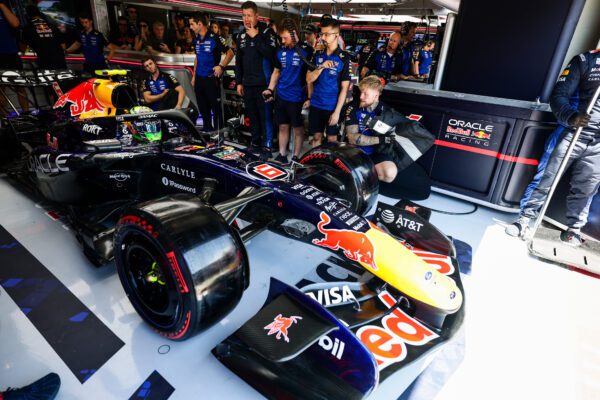





Formula 1 cars are engineered to precise specifications, with their weight being a critical factor governed by the sport’s technical regulations. For the 2026 season, the minimum weight for a Formula 1 car, including the driver and tyres, has been set at 768 kilograms.
This figure represents a significant reduction compared to previous seasons, marking a deliberate effort by the FIA to make the cars more agile and responsive on track.
The 2026 Formula 1 minimum weight
The minimum weight for a Formula 1 car in 2026 is officially 768 kilograms. This new regulation sees a decrease of 32 kilograms from the 800-kilogram limit that was in place for the 2025 season.
The reduction aims to reverse a long-standing trend of increasing car weight in the sport.
Under Article C4.1 of the 2026 Technical Regulations, the minimum weight is specifically defined as 724 kilograms for the car chassis, plus the Nominal Tyre Mass. The Nominal Tyre Mass refers to the average weight of a set of new dry tyres, which is measured by Pirelli before the season commences.
This total weight encompasses the car itself, its fitted tyres, and the driver along with their seat and driving equipment. However, it is important to note that the safety harness and any fuel are excluded from this minimum weight calculation.
For qualifying and sprint qualifying sessions, the base figure for the car’s weight is slightly higher, set at 726 kilograms. This adjustment accounts for specific operational parameters during these critical sessions.
A crucial aspect of the weight regulations involves the driver, who, along with any necessary ballast, must weigh at least 82 kilograms. This rule was introduced to ensure fairness, preventing lighter drivers from gaining an inherent performance advantage.


If a driver’s combined weight with their equipment falls below this 82-kilogram threshold, ballast must be added to the cockpit to meet the minimum requirement. Furthermore, in instances where the FIA declares a ‘Heat Hazard’, the minimum car weight increases by 5 kilograms for the race and 2 kilograms for other sessions, allowing for additional cooling equipment.
| component | approximate weight (kg) |
|---|---|
| minimum car & driver (2026) | 768 |
| driver + ballast minimum | 82 |
| engine (power unit) | 150 |
| gearbox | 40 |
| halo safety device | 7 |
| front wing | 10 |
| fuel (maximum capacity) | 110 |
Components contributing to Formula 1 car weight
A Formula 1 car is a complex machine, with numerous components meticulously designed to meet both performance and weight targets. The power unit, comprising the internal combustion engine and hybrid elements, is one of the heaviest individual components, with a minimum weight of 150 kilograms.
The gearbox typically weighs around 40 kilograms, contributing significantly to the car’s overall mass. Safety features, such as the Halo cockpit protection device, add approximately 7 kilograms to the car’s structure.
Aerodynamic elements like the front wing weigh around 10 kilograms. While the chassis or monocoque does not have a specific standalone weight regulation, its construction from advanced carbon fibre composites is important for maintaining structural integrity while minimizing mass.
Fuel is another substantial factor, though it is excluded from the minimum car weight calculation. A full fuel tank can hold up to 110 kilograms of fuel, making a car considerably heavier at the start of a race.
The evolution of Formula 1 car weight
The weight of Formula 1 cars has undergone a dramatic evolution throughout the sport’s history, generally trending upwards for many decades. In the 1960s, early F1 vehicles were considerably lighter, weighing approximately 500 kilograms.
By the mid-1990s, the minimum weight stood at 595 kilograms, a figure that remained relatively stable for over a decade. The introduction of new regulations and technologies steadily pushed this limit higher.
The advent of the turbo-hybrid era in 2014 saw a significant jump to 690 kilograms, primarily due to the increased complexity and mass of the hybrid power units. Subsequent years continued this upward trajectory, with the minimum weight reaching 795 kilograms in 2022.
Further increases brought the weight to 798 kilograms for the 2023 and 2024 seasons, and then to 800 kilograms in 2025. These increases were largely driven by enhanced safety measures, such as stronger chassis designs, larger crash structures, and the mandatory introduction of the Halo device in 2018.
Larger wheel and tyre dimensions, along with the requirement for cars to complete races on a single tank of fuel, also contributed to the escalating weight. The 2026 regulations represent the first significant reversal of this trend in many years, aiming for lighter and more agile machinery.
Why weight matters in Formula 1
Weight is a fundamental performance parameter in Formula 1, directly influencing a car’s speed, handling, and tyre degradation. A lighter car can accelerate more rapidly, brake later into corners, and change direction with greater agility.
This enhanced responsiveness allows drivers to push harder and extract more performance over a lap. Conversely, a heavier car places greater stress on its tyres, leading to increased wear and potentially requiring more conservative driving strategies.
Experts estimate that every 10 kilograms of weight in a Formula 1 car can equate to approximately 0.35 seconds per lap, depending on the circuit characteristics. Therefore, the 32-kilogram weight reduction for 2026 is anticipated to be worth around a second in lap time.
Teams meticulously manage weight distribution to optimize the car’s balance and handling characteristics. Strategic placement of ballast is used to achieve the ideal center of gravity, which is typically slightly rear-biased to maximize traction from the powerful rear wheels.
Future weight reduction targets
While the 2026 regulations have already delivered a notable weight reduction, the FIA has ambitious plans for further decreases in the coming years. The sport’s governing body aims to bring Formula 1 cars below 700 kilograms for the next regulation cycle, potentially by 2030 or 2031.
This long-term objective is part of a broader strategy to create even more dynamic and exciting racing. Plans for achieving this target include significant reductions in turbo pressures and simplification of engine inlet and outlet systems.
Further weight savings are anticipated from potentially dropping heavy battery systems, possibly with a return to V8 engines, and a reduction in wheel rim size. The FIA believes that a concerted effort across various technical areas can comfortably achieve a sub-700-kilogram car.
This continued focus on weight reduction underscores the sport’s commitment to innovation and performance, while also addressing concerns about the increasing size and mass of modern Formula 1 machinery. The goal is to ensure that future generations of F1 cars remain at Formula 1 engineering and driver skill.