



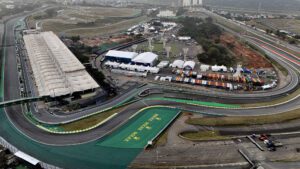
The Autódromo José Carlos Pace, universally known as Interlagos, stands as a cornerstone of motorsport in Brazil and a revered venue on the Formula 1 calendar. Located in São Paulo, its name, meaning ‘between the lakes’ in Portuguese, refers to its position between the Guarapiranga and Billings reservoirs.
This iconic circuit has hosted Formula 1 for decades, consistently delivering dramatic and memorable races. Its unique characteristics and rich history make it a favourite among drivers and fans alike.
Circuit layout and unique characteristics
The current Interlagos circuit measures 4.309 kilometres (2.677 miles) in length, featuring 15 challenging turns. It is one of the few circuits on the Formula 1 calendar that runs in a counter-clockwise direction, placing unusual strain on drivers’ neck muscles.
The track is renowned for its significant elevation changes, with a total difference of approximately 43 metres between its highest and lowest points. This undulating terrain contributes to its demanding nature and creates a dynamic driving experience.
Key sections of the circuit include the famous ‘Senna S’ (Turns 1 and 2), a downhill left-right chicane that serves as a prime overtaking spot. Following this, the ‘Curva do Sol’ (Turn 3) leads onto the long ‘Reta Oposta’ straight, another crucial area for slipstreaming and passing manoeuvres.
The middle sector winds through a series of technical corners such as ‘Descida do Lago’ (Turns 4 and 5), ‘Ferradura’ (Turns 6 and 7), ‘Laranjinha’ (Turn 8), ‘Pinheirinho’ (Turn 9), ‘Bico de Pato’ (Turn 10), and ‘Mergulho’ (Turn 11). These sections demand precision and a responsive car setup.
The lap concludes with ‘Junção’ (Turn 12), an uphill left-hander that propels cars onto the long climb of ‘Subida dos Boxes’ (Turns 14 and 15) towards the start-finish line. This final ascent places a premium on traction and engine power.
A rich history of Formula 1
The Autódromo José Carlos Pace was inaugurated on May 12, 1940, originally known simply as Autódromo de Interlagos. Its design drew inspiration from circuits like Brooklands, Roosevelt Raceway, and Montlhéry.

Formula 1 first visited Interlagos for a non-championship race in 1972, won by Carlos Reutemann. The circuit then hosted its inaugural World Championship Brazilian Grand Prix in 1973, where local hero Emerson Fittipaldi claimed victory.
Due to safety concerns regarding its original 7.960-kilometre layout and bumpy surface, the Grand Prix moved to Rio de Janeiro’s Jacarepaguá circuit for periods in the late 1970s and 1980s. A significant redesign in 1990 shortened Interlagos to its current configuration, facilitating its return to the F1 calendar.
The circuit was officially renamed in 1985 to honour Brazilian Formula 1 driver José Carlos Pace, who tragically died in a plane crash in 1977. In 2024, his remains were moved to the circuit for their final resting place.
Interlagos has been the scene of numerous championship deciders, including the dramatic 2007 and 2008 seasons. Ayrton Senna’s emotional home victory in 1991, achieved despite a failing gearbox, remains one of the sport’s most celebrated moments.
The sao paulo Grand Prix today
Since 2021, the event at Interlagos has been officially known as the São Paulo Grand Prix, reflecting a new commercial agreement and promoter. The circuit holds a contract to host Formula 1 until at least 2030.
The 2026 São Paulo Grand Prix, held on November 8, saw Lando Norris take victory, while Mercedes secured the Constructors’ Championship. Lewis Hamilton also marked his 400th career start at this event.
Interlagos is renowned for its passionate crowd, with a race day capacity of approximately 97,000 spectators. The natural amphitheatre layout allows many fans to view a significant portion of the track from the grandstands.
The weather at Interlagos is notoriously unpredictable, with sudden rain showers often impacting race strategies and leading to thrilling, chaotic events. November, falling early in São Paulo’s wet season, frequently brings afternoon storms.
Technical demands and overtaking opportunities
Driving at Interlagos presents a unique challenge due to its counter-clockwise direction, undulating profile, and combination of high-speed sections with tight, technical corners. Teams must find a delicate balance in their car setup to optimise both straight-line speed and cornering grip.
The circuit’s bumpy surface, even after resurfacing efforts, adds another layer of complexity for drivers and engineers. Traction out of slow corners and a strong run onto the straights are critical for competitive lap times.
Overtaking opportunities are primarily found at the ‘Senna S’ (Turns 1 and 2) and under braking for ‘Descida do Lago’ (Turn 4) at the end of the ‘Reta Oposta’. Drivers often utilise slipstreaming and energy deployment in these zones.
The long uphill run from ‘Junção’ to the finish line also creates a unique dynamic, where exit speed from Turn 12 is paramount for defending or launching an attack into Turn 1. The 2026 regulations, including ‘Straight Mode’ and ‘Overtake Mode’, further influence these strategic battles.
Interlagos circuit specifications
| Official Name | Autódromo José Carlos Pace |
| Common Name | Interlagos |
| Location | São Paulo, Brazil |
| Opened | May 12, 1940 |
| Current Length | 4.309 km (2.677 miles) |
| Number of Turns | 15 (10 left, 5 right) |
| Direction | Counter-clockwise |
| Elevation Change | ~43 metres |
| Altitude | ~780-800 metres above sea level |
| FIA Grade | 1 |
| Race Lap Record | 1:10.540 (Valtteri Bottas, Mercedes, 2018) |
| Race Laps | 71 |
| Race Distance | 305.879 km |
| Capacity (Race Day) | ~97,000 spectators |
| F1 Contract Until | At least 2030 |