


The Shanghai International Circuit stands as a premier motorsport facility in China, purpose-built to host the Formula 1 Chinese Grand Prix. Located in the Jiading District of Shanghai, the circuit first welcomed Formula 1 in 2004.
It has since become a significant fixture on the global motorsport calendar, renowned for its distinctive design and challenging characteristics.
The circuit’s layout is famously inspired by the Chinese character ‘上’ (shang), which translates to ‘above’ or ‘ascend’, reflecting Shanghai’s ambition and prosperity. This symbolic design creates a unique blend of high-speed straights and intricate corner sequences, demanding precision and strategic acumen from drivers and teams alike.
Circuit design and construction
Designed by the acclaimed German architect Hermann Tilke, construction of the Shanghai International Circuit began in April 2003 and was completed by June 6, 2004. The ambitious project cost approximately ¥2.6 billion, equivalent to about $450 million.
The site, originally swampland and rice paddies, required extensive groundwork and involved around 3,000 workers over an 18-month period. This monumental engineering feat transformed the challenging terrain into a state-of-the-art FIA Grade 1 facility.
The paddock facilities are uniquely arranged like pavilions in a lake, drawing inspiration from Shanghai’s ancient Yu Garden. The main grandstand alone can accommodate 30,000 spectators, contributing to the circuit’s total capacity of 200,000.
Track characteristics and challenges
The 5.451-kilometer (3.387-mile) circuit features 16 turns, comprising seven left-handers and nine right-handers. Its design presents a demanding test of both car and driver, with a mix of heavy braking zones, long sweeping corners, and high-speed sections.
A signature feature is the tightening spiral of Turns 1 and 2, where cars enter at approximately 185 km/h before scrubbing speed through an almost 360-degree turn. This decreasing-radius complex places significant and sustained load on the front-left tyre.
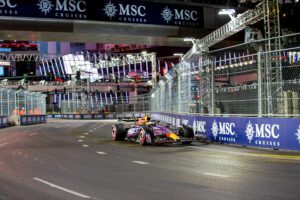

Conversely, Turns 11 through 13 form an opening spiral, an increasing-radius complex that acts as a rhythmic counterpart to the opening corners. A clean exit from this section is important as it leads onto one of Formula 1’s longest straights.
The back straight, stretching between Turns 13 and 14, measures approximately 1.170 to 1.2 kilometers. Cars can reach top speeds of up to 327 km/h here, making the Turn 14 hairpin at its end a primary overtaking opportunity under heavy braking.
The circuit’s elevation changes are minimal, with a maximum uphill gradient of 3% and a maximum downhill gradient of 8%. The lowest point is 4.50 meters and the highest is 11.24 meters above sea level.
Tyre management is a critical factor at Shanghai, particularly for the front-left tyre, which endures considerable stress through the circuit’s long, sweeping corners. The track was resurfaced ahead of the 2025 Chinese Grand Prix, impacting grip levels and tyre graining.
The circuit incorporates four ‘Straight Mode’ zones, similar to DRS zones, allowing cars to adapt between different aerodynamic configurations. These zones are located on the start/finish straight, between Turns 4 and 6, between Turns 10 and 11, and on the long straight leading to Turn 14.
Chinese Grand Prix history
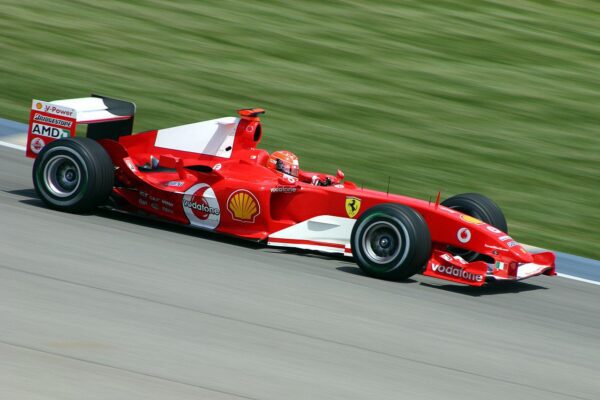
The inaugural Chinese Grand Prix was held on September 26, 2004, with Rubens Barrichello securing victory for Ferrari. The event was a consistent fixture on the Formula 1 calendar from 2004 until 2019.
The race experienced a hiatus from 2020 to 2023 due to the COVID-19 pandemic but made its return in 2024. Formula 1 has since extended its contract with the race promoter, ensuring the Chinese Grand Prix remains on the calendar until at least 2030.
The Shanghai International Circuit hosted Formula 1’s 1000th Grand Prix in 2019. The Chinese Grand Prix is often considered an early-season technical reality check, as its balanced demands on car performance reveal genuine competitiveness.
Notable records and winners
Michael Schumacher holds the official F1 race lap record, set in 2004 with a time of 1:32.238 for Ferrari. This record has stood for nearly two decades, despite significant regulation changes and the circuit’s resurfacing.
The all-time fastest qualifying lap was set by Oscar Piastri in 2025, achieving a 1:30.641 for McLaren. Lewis Hamilton is the most successful driver at the Chinese Grand Prix, with six victories across his career.
Recent winners include Max Verstappen in 2024 and Oscar Piastri in 2025. In 2026, Kimi Antonelli became the youngest polesitter and winner in F1 history at this circuit, driving for Mercedes.
| category | detail |
|---|---|
| circuit length | 5.451 km (3.387 miles) |
| number of turns | 16 |
| race distance | 56 laps (305.066 km) |
| official race lap record | 1:32.238 (michael schumacher, 2004) |
| all-time fastest qualifying lap | 1:30.641 (oscar piastri, 2025) |
| circuit designer | hermann tilke |
| opening date | june 6, 2004 |
| spectator capacity | 200,000 |
| most wins (driver) | lewis hamilton (6) |
| year | winner | constructor |
|---|---|---|
| 2004 | rubens barrichello | ferrari |
| 2005 | fernando alonso | renault |
| 2006 | michael schumacher | ferrari |
| 2007 | kimi räikkönen | ferrari |
| 2008 | lewis hamilton | mclaren |
| 2009 | sebastian vettel | red bull racing |
| 2010 | jenson button | mclaren |
| 2011 | lewis hamilton | mclaren |
| 2012 | nico rosberg | mercedes |
| 2013 | fernando alonso | ferrari |
| 2014 | lewis hamilton | mercedes |
| 2015 | lewis hamilton | mercedes |
| 2016 | nico rosberg | mercedes |
| 2017 | lewis hamilton | mercedes |
| 2018 | daniel ricciardo | red bull racing |
| 2019 | lewis hamilton | mercedes |
| 2024 | max verstappen | red bull |
| 2025 | oscar piastri | mclaren |
| 2026 | kimi antonelli | mercedes |