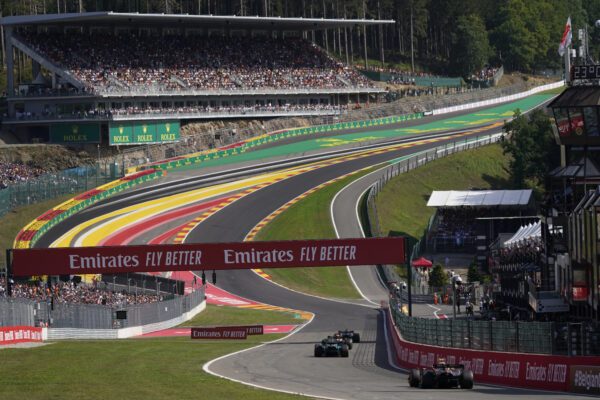




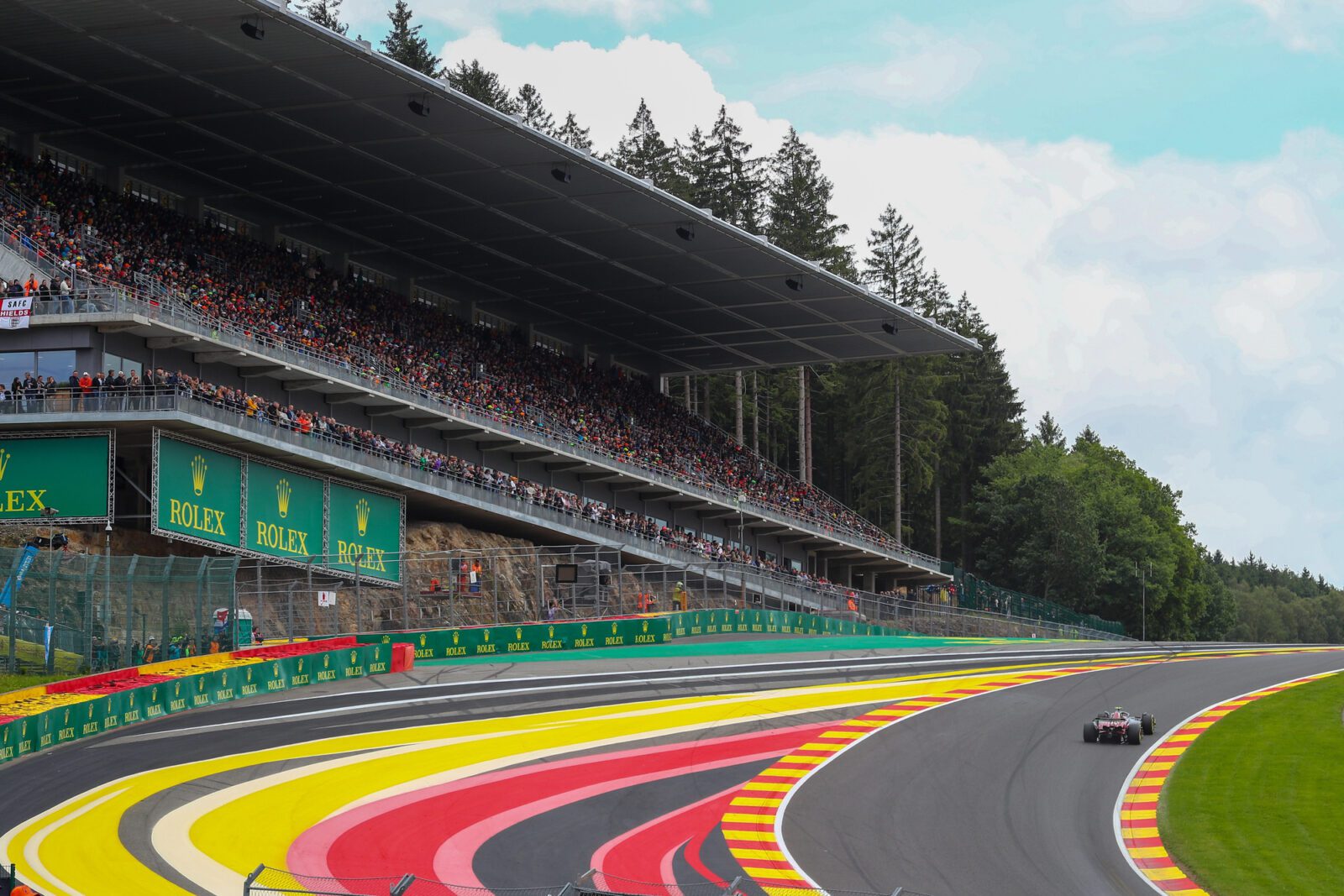
The Circuit de Spa-Francorchamps, often simply referred to as Spa, stands as one of Formula 1’s most iconic and revered venues. Nestled within the undulating hills and dense forests of the Belgian Ardennes, it is celebrated for its high-speed corners, dramatic elevation changes, and notoriously unpredictable weather conditions.
This unique combination presents an unparalleled challenge for both drivers and engineers, solidifying its reputation as a true ‘driver’s circuit’.
The circuit has a rich history dating back to its inception in 1921, initially utilizing public roads connecting Francorchamps, Malmedy, and Stavelot. The original layout measured approximately 15 kilometres (9.3 miles) and was renowned for its extraordinary speed.
Over the decades, safety concerns led to significant modifications, most notably in 1979 when the track was shortened to its current permanent 7.004-kilometre (4.352-mile) configuration.
Circuit layout and evolution
The modern Circuit de Spa-Francorchamps, while significantly shorter than its predecessor, retains much of its original character and challenge. It is the longest circuit on the current Formula 1 calendar, featuring 19 turns and a remarkable 104-meter (341-foot) elevation change from its lowest to highest points.
This expansive and varied layout demands a delicate balance in car setup, requiring teams to compromise between optimizing for long straights and excelling through the demanding, twisty middle sector.
The circuit has undergone several redesigns throughout its history, with significant safety upgrades implemented for the 2022 season. These improvements included additional run-off areas at Raidillon de l’Eau Rouge and the modification or addition of gravel traps at corners such as La Source, Les Combes, Speaker’s Corner, Pouhon, Stavelot, and Blanchimont.
These changes aimed to enhance safety while preserving the circuit’s unique and challenging nature.
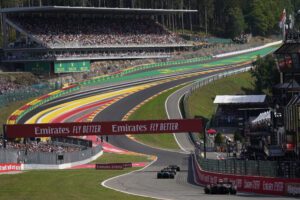
Eau rouge and raidillon: the ultimate test
The iconic Eau Rouge and Raidillon complex is arguably the most famous and recognizable corner sequence in motorsport. While often referred to collectively as Eau Rouge, the name technically belongs to the left-hand bend at the bottom of the valley, with Raidillon being the steep uphill right-left sweep that follows.
This sequence was created in 1939, replacing the slower Ancienne Douane U-turn to increase average speeds.
Drivers approach Eau Rouge downhill at high speed after exiting La Source, then sweep left through Eau Rouge at the bottom of the valley before climbing sharply right through Raidillon. This section gains approximately 40 metres (131 feet) in altitude on a gradient of up to 17%.
In modern Formula 1 cars, this entire complex is typically taken flat-out in dry conditions, with speeds exceeding 300 km/h (186 mph).
The compression at the bottom of Eau Rouge and the blind crest over Raidillon generate immense G-forces, pushing the car to its aerodynamic limits and making it one of the most physically demanding sequences on the calendar. Maintaining control through this section requires absolute precision, commitment, and confidence in the car’s balance.
Mistakes here can lead to significant accidents due to the high speeds involved.
Key corners and sectors
The lap at Spa-Francorchamps begins with the tight, hard-braking La Source hairpin, immediately after the start/finish line. A good exit from La Source is important as it leads directly into the downhill plunge towards Eau Rouge and Raidillon, dictating the momentum carried into this legendary section.
La Source is also a key overtaking hotspot and is strategically important due to its proximity to the pit lane entry.
Following the ascent of Raidillon, cars accelerate onto the Kemmel Straight, a long full-throttle stretch where speeds can exceed 340 km/h (211 mph). This straight leads into the heavy braking zone of Les Combes, a right-left chicane that serves as another prime overtaking opportunity.
The middle sector features a series of fast, flowing corners, including Malmedy, Rivage, Pouhon, Fagnes, and Campus.
Pouhon, a long, double-apex left-hander, is particularly notable as it is often taken with a lift of the throttle but no braking in modern F1 cars, demanding immense commitment and car balance. The circuit then sweeps through Stavelot and Blanchimont, a high-speed left-hand bend, before drivers prepare for the final Bus Stop chicane.
The Bus Stop chicane, a right-left sequence, requires precise braking and a strong exit to maximize speed onto the start/finish straight.
Strategic considerations and challenges
Spa-Francorchamps is renowned for its unpredictable weather, often referred to as “Spa weather,” where one part of the track can be experiencing heavy rain while another remains completely dry. This phenomenon creates significant strategic challenges for teams, forcing quick decisions on tire choices and setup adjustments.
The long lap distance also means that mistimed pit stops can be severely punished.
The circuit’s blend of long straights and high-speed corners necessitates a compromise in aerodynamic setup. Teams must decide whether to prioritize low downforce for top speed on the Kemmel Straight and other fast sections or opt for higher downforce to gain grip through the demanding middle sector.
This decision directly impacts both qualifying performance and raceability, particularly regarding overtaking opportunities.
Overtaking is a prominent feature at Spa, facilitated by multiple long straights and heavy braking zones, especially into Les Combes and the Bus Stop chicane. The Kemmel Straight, in particular, often sees slipstream battles and DRS trains.
For the 2026 season, Formula 1 has introduced five ‘Straight Mode Zones’ at Spa, replacing DRS, where cars can flatten their wings for reduced drag, further emphasizing straight-line speed.
Circuit specifications
| Characteristic | Detail |
|---|---|
| Location | Stavelot, Belgium |
| Opened | August 1921 |
| Current Layout Introduced | 1979 (major shortening) |
| FIA Grade | 1 (GP) |
| Circuit Length | 7.004 km (4.352 miles) |
| Number of Turns | 19 |
| Direction | Clockwise |
| Elevation Change | 104 meters (341 feet) |
| Number of Laps (F1 GP) | 44 |
| Race Distance (F1 GP) | 308.052 km (191.415 miles) |
| Official F1 Lap Record | 1:44.701 – Sergio Perez (2024, Red Bull) |
| Fastest Ever F1 Lap | 1:40.510 – Oscar Piastri (2025, McLaren, Sprint Qualifying) |
| 2026 Belgian Grand Prix Date | July 17-19, 2026 |
| Straight Mode Zones (2026 F1) | 5 |