



The Formula 1 starting grid is a precisely marked area on the circuit where cars line up before a Grand Prix or Sprint race begins. Each driver must position their car accurately within a designated grid box, a task that has become increasingly challenging with modern car designs.
Strict regulations govern these dimensions and the consequences for incorrect alignment, directly influencing the race’s initial moments.
The final starting order is not solely determined by qualifying performance; various penalties can alter a driver’s grid position, making the official grid a complex interplay of speed and adherence to rules.
Evolution of Formula 1 grid box dimensions
The dimensions of Formula 1 grid boxes have evolved to accommodate changes in car design and address driver visibility issues. In the 2022 season, grid boxes measured 2.3 meters in width, but the introduction of new chassis and aerodynamic regulations, coupled with larger 18-inch tires, significantly hampered drivers’ ability to accurately position their cars.
Recognizing these challenges, the FIA increased the width of the grid boxes to 2.5 meters for the start of the 2023 season. However, incidents involving drivers like Esteban Ocon and Fernando Alonso receiving penalties for incorrect alignment in early 2023 races prompted further adjustments.
Consequently, from the 2023 Australian Grand Prix onwards, the FIA widened the grid boxes once more to 2.7 meters. This change aimed to provide drivers with greater tolerance and reduce the likelihood of penalties stemming from poor visibility from the cockpit.
| Season | Grid Box Width | Reason for Change |
|---|---|---|
| 2022 | 2.3 meters | Standard regulation |
| Early 2023 | 2.5 meters | Accommodate new-generation cars |
| Post-Australian GP 2023 | 2.7 meters | Address driver visibility and alignment penalties |
Grid box markings and driver visibility challenges
Grid boxes are clearly delineated on the track surface by white lines, forming a staggered 1×1 formation with rows separated by 16 meters. To assist drivers with longitudinal positioning, a long yellow line typically extends approximately four meters to the right of each grid slot.
Drivers are instructed to align their right front tire with this yellow line, and pressure plates beneath the line can notify race control of correct positioning. Despite these visual aids, the low seating position and the design of modern Formula 1 cars, particularly the larger 18-inch tires and wheel fairings introduced in 2022, severely restrict a driver’s view of the track immediately in front and to the sides.

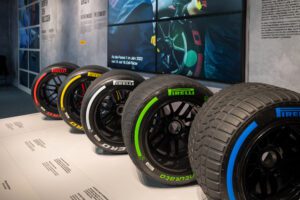
This limited visibility makes precise alignment a genuine challenge, as drivers often report only seeing the top few inches of their tires. Some circuits have even trialed additional central guide lines within the grid boxes to further assist drivers with lateral positioning.
Starting grid alignment penalties
Drivers are required to position their cars entirely within the white lines of their designated grid box before the start of a race. Failure to do so, such as stopping with a tire slightly outside the markings, constitutes an incorrect starting location infringement.
Such infringements typically result in a five-second time penalty, which can be served during a pit stop or added to the driver’s total race time. These penalties have been a source of frustration for drivers and teams, particularly given the aforementioned visibility difficulties.
The FIA’s decision to widen grid boxes in 2023 was a direct response to these penalties and driver feedback, aiming to provide more leeway and reduce the frequency of such sanctions. The objective is to ensure fair competition while acknowledging the practical difficulties faced by drivers.
Broader Formula 1 grid penalties and their application
Beyond incorrect alignment, numerous other infringements can lead to grid penalties, altering the provisional starting order derived from qualifying. Common reasons include exceeding the permitted allocation of power unit components, such as the internal combustion engine, turbocharger, or exhaust system.
Sporting infringements, such as impeding another driver during a qualifying lap or dangerous driving, can also result in grid drops, typically ranging from three to five places. Penalties can also carry over from previous races or be imposed for breaches of parc fermé regulations, which restrict car modifications between qualifying and the race.
A driver accumulating more than 15 cumulative grid-place penalties in a single event is mandated to start from the back of the grid, behind all other classified drivers. In severe cases, or for certain parc fermé breaches, a driver may be required to start from the pit lane, joining the race after the entire field has cleared the grid.
The 2026 FIA sporting regulations context
The FIA Formula 1 Sporting Regulations are updated annually, with significant overhauls occurring periodically to shape the sport’s future. The 2026 regulations, for instance, introduce substantial changes to both chassis and power unit specifications.
These changes include a reduced wheelbase (3400mm), narrower width (1900mm), and a lower minimum weight (770kg), all designed to make the cars more agile. The power units will also see a shift to an approximate 50/50 split between internal combustion and electric power, alongside the introduction of active aerodynamics.
While these technical changes primarily affect car performance, they indirectly influence the context of grid box alignment by altering car dimensions and potentially driver visibility. The FIA’s ongoing commitment to safety and fairness ensures that grid procedures and penalties remain a critical aspect of Formula 1 competition.