




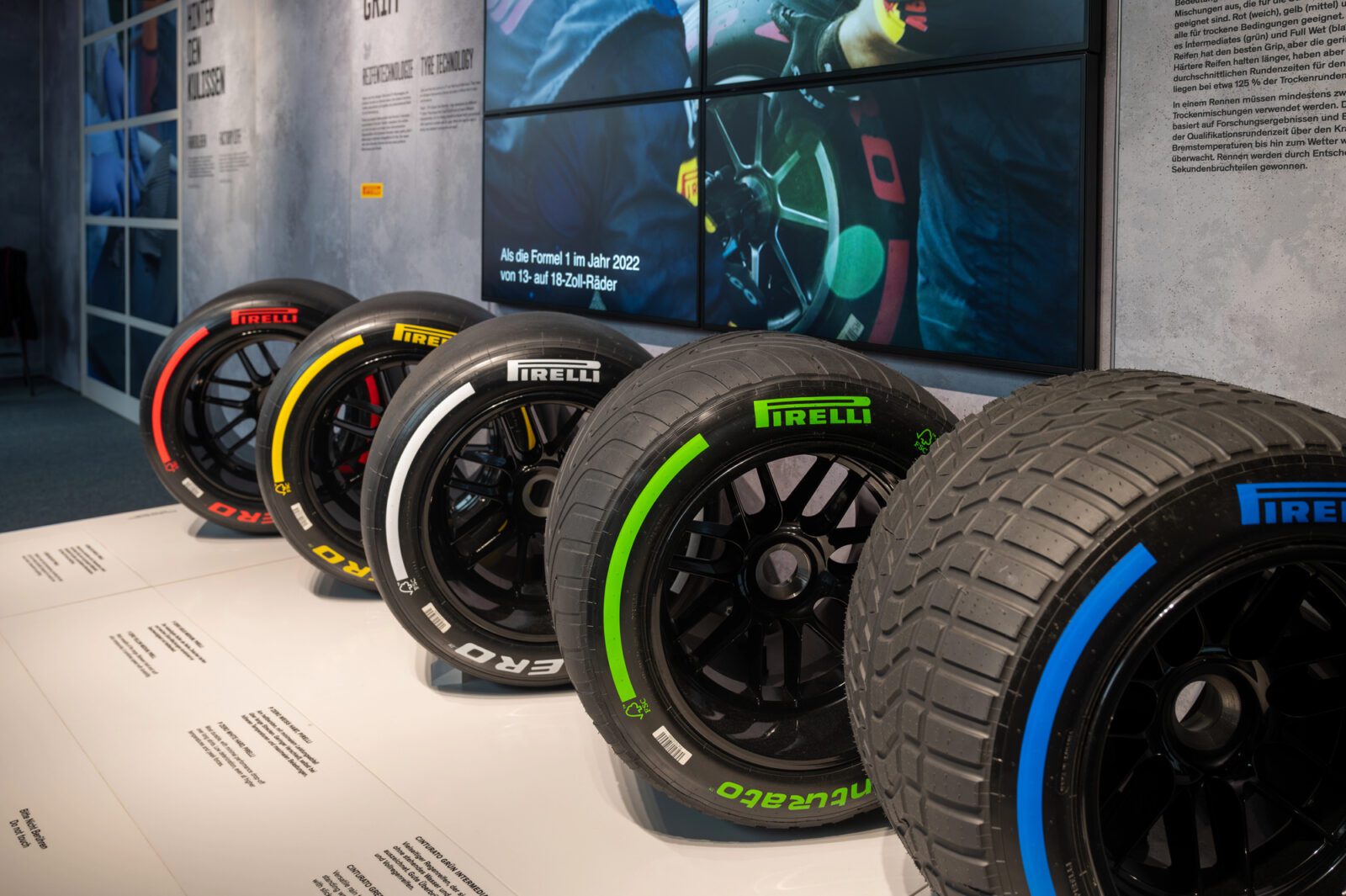
Rubber marbles are a ubiquitous sight on Formula 1 tracks, representing small balls or pellets of shed tire rubber that accumulate during a race. These fragments are a direct consequence of the extreme forces and temperatures endured by the bespoke Pirelli tires.
Their presence significantly influences car performance and race strategy, particularly concerning grip levels away from the optimal racing line.
The formation and nature of rubber marbles
Formula 1 tires are engineered for maximum mechanical grip, which inherently leads to rapid wear and degradation. As cars navigate the circuit, the intense friction and heat cause microscopic pieces of rubber to peel off the tire surface through processes like blistering and graining.
These detached rubber particles are then flung outwards by centrifugal force and aerodynamic turbulence.
The racing line, the fastest path around a circuit, is constantly driven over by cars, which tends to clear it of debris. Consequently, the shed rubber accumulates in wide bands just outside this optimal line, particularly at the exits of fast corners and along the outer edges of the track.
Factors such as hot ambient temperatures, abrasive track surfaces, and the use of softer tire compounds all contribute to a greater volume of marble production throughout a Grand Prix weekend.
Grip reduction and the racing line
Driving over rubber marbles drastically reduces a Formula 1 car’s grip, often likened to driving on ball bearings. These loose pellets prevent the tire’s contact patch from fully engaging with the asphalt, leading to a significant loss of traction.
This phenomenon directly impacts a driver’s ability to maintain speed through corners and extends braking distances.

The presence of marbles effectively enforces the racing line, as venturing onto the dirty part of the track results in an immediate and substantial performance penalty. Drivers must meticulously adhere to the rubbered-in groove to extract maximum performance, making any deviation a high-risk maneuver.
This stark contrast in grip levels between the racing line and off-line areas is a critical consideration for every lap.
Implications for overtaking and race strategy
The severe grip loss caused by rubber marbles profoundly impacts overtaking opportunities in Formula 1. A driver attempting to pass a competitor off the racing line risks losing crucial time and control, making such maneuvers incredibly challenging.
This often forces overtakes to occur primarily under braking zones or with the aid of DRS, rather than through high-speed corners.
Many drivers have voiced concerns about the slickness and difficulty of driving off-line, with some even attributing crashes to inadvertently picking up marbles. Sebastian Vettel and Paul di Resta, among others, have highlighted how the sheer volume of rubber debris can make late-race overtaking particularly arduous.
This dynamic also influences defensive driving, as a driver can effectively protect their position by forcing an attacker onto the marble-laden sections of the track.
Pirelli’s role and track management
Pirelli, as Formula 1’s sole tire supplier, designs its compounds with intentional degradation to promote more strategic racing and spectacle. This design philosophy, however, inherently leads to a significant increase in rubber deposits on the track.
While Pirelli acknowledges the issue, their primary objective remains to provide tires that challenge teams and drivers with wear characteristics.
Circuits and the FIA implement measures to manage marble accumulation, though these are typically limited. Track sweepers are sometimes deployed between sessions, especially at street circuits, to clear off-line areas.
Additionally, Pirelli and the FIA review tire compound choices for circuits historically known for severe marble fields, such as Bahrain and Circuit de Barcelona-Catalunya, to mitigate their impact on racing.
The post-race weighbridge tactic
Despite being a hindrance during the race, rubber marbles play an unexpected role after the checkered flag. Formula 1 cars, along with their drivers, must meet a strict minimum weight requirement during post-race scrutineering.
Over the course of a Grand Prix, cars lose weight due to fuel burn and tire wear, while drivers also lose body fluids.
To ensure they remain above the minimum weight limit and avoid disqualification, drivers often deliberately weave through the marble-laden sections of the track on their in-lap. The hot tires pick up these sticky rubber pellets, adding a small but potentially crucial amount of weight back to the car.
A notable instance occurred at the 2024 Belgian Grand Prix, where George Russell was disqualified for being 1.5 kg underweight, with the absence of a cool-down lap to collect rubber cited as a contributing factor. This highlights the fine margins involved and the strategic importance of even these seemingly insignificant rubber fragments.
| aspect | description |
|---|---|
| composition | shed tire rubber pellets |
| formation factors | tire wear, blistering, graining, hot tracks, abrasive surfaces, soft compounds |
| grip impact | significant reduction, akin to driving on ball bearings |
| racing line effect | enforces optimal line, penalizes off-line driving |
| overtaking challenge | severely hinders off-line passes, favors braking zones |
| post-race use | picked up to add weight for FIA scrutineering |
| minimum car weight (2024) | 798 kg (including driver) |