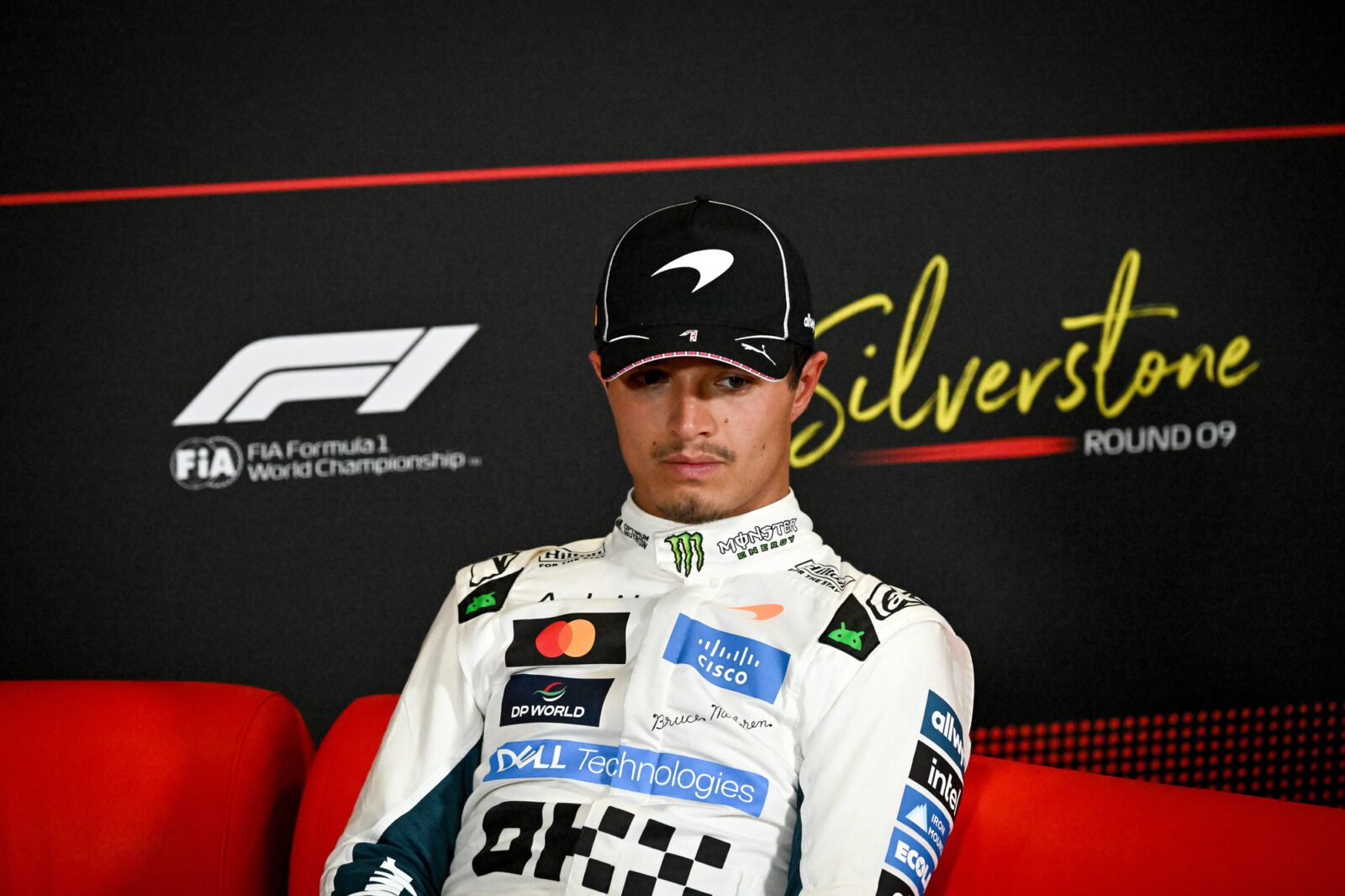
McLaren driver Lando Norris has stated that Formula 1 must address a fundamental issue with its current generation of cars, specifically an artificial “speed limit” that is hindering overtaking. Norris articulated his concerns following the Mexican Grand Prix, where he found himself unable to pass Charles Leclerc despite a clear pace advantage.
Norris described the situation as a literal limiter preventing cars from exceeding a certain speed. He explained that even when a driver closes the gap significantly, both cars reach the same speed ceiling, nullifying any potential overtaking opportunity.
The 2026 Formula 1 season introduced a comprehensive regulatory overhaul, designed to promote closer racing and enhance the on-track spectacle. Key changes included a near 50-50 split between internal combustion and electrical power, a significant increase from the previous 80:20 ratio.
Under these new power unit regulations, the MGU-H component was removed, with all electrical energy now generated through kinetic energy recovery (MGU-K) during braking and direct harvesting from the engine. The MGU-K’s power output was nearly tripled to 350kW.
Additionally, the 2026 rules brought in active aerodynamics, allowing cars to switch between a low-drag “X-mode” on straights and a high-downforce “Z-mode” for corners. An “Override Mode,” also known as a “Boost Button,” provides an extra burst of electrical power, delivering the full 350kW up to 355 km/h, but is only available when a driver is within one second of the car ahead.
The FIA’s intention with these changes was to reduce dirty air, which historically made following other cars difficult, and to create more overtaking opportunities. The energy deployment limits at the end of straights were specifically designed to aid the “overtake mode.”
However, Norris has been a consistent critic of the 2026 regulations’ impact on racing. Earlier in the season, during the Japanese Grand Prix, he reported an “accidental overtake” on Lewis Hamilton due to uncontrolled battery deployment, which subsequently left him vulnerable.
The incident at the Mexican Grand Prix underscored Norris’s concerns. Despite Charles Leclerc’s car suffering from locked-up front tyres and a damaged left front, Norris was unable to execute a pass on the long 1.2-kilometre straight of the Autódromo Hermanos Rodríguez over the final 24 laps. Lewis Hamilton also faced similar difficulties attempting to overtake Max Verstappen.


Other drivers have echoed frustrations regarding energy management, with Max Verstappen reportedly considering his future in F1 due to its influence on racing. The FIA’s single-seater director, Nikolas Tombazis, acknowledged these concerns in January 2026, stating the governing body would monitor the situation and had mechanisms to adjust the rules if necessary.
In response to driver feedback and safety concerns, the FIA implemented refinements to the 2026 regulations in April. These adjustments included a reduction in the maximum permitted energy recharge in qualifying and specific MGU-K deployment limits to manage closing speeds and maintain overtaking opportunities.
Norris has called for further improvements for the 2027 season, highlighting the disparity between F1 car speeds and those of motorcycles, which can reach 370 km/h. He argues that F1 cars should theoretically be capable of higher speeds.