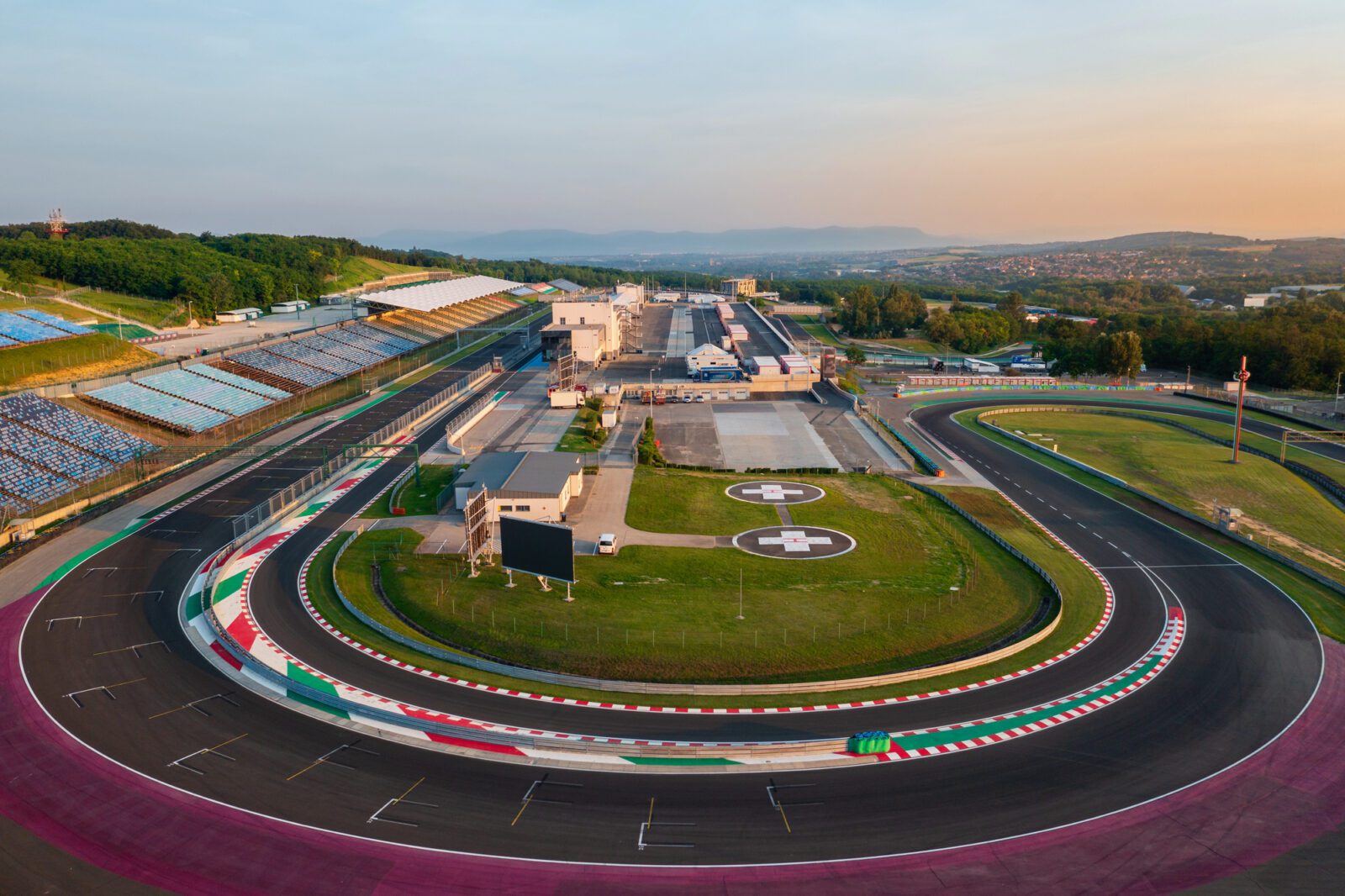
The Hungaroring, nestled in a natural amphitheatre near Budapest, Hungary, has been a staple of the Formula 1 calendar since 1986. This circuit is renowned for its tight, twisty layout and is frequently dubbed ‘Monaco without walls’ due to its demanding nature and limited overtaking opportunities.
Drivers consistently face a physically challenging race, often under high summer heat, requiring continuous focus and a well-balanced car.
The track’s design prioritizes technical corners over high-speed sections, making it a true test of a driver’s precision and skill. Its undulating terrain, with a 36-meter elevation change from the paddock to the lowest point near Turn 6, adds another layer of complexity to mastering a lap.
The hungaroring: a technical challenge
The Hungaroring circuit is characterized by a relentless series of corners, offering little respite for drivers. This constant cornering places a significant emphasis on aerodynamic grip and mechanical balance.
Teams typically opt for high-downforce setups, similar to those used at circuits like Monaco or Singapore, to maximize performance through the numerous turns.
The track surface itself can be abrasive, contributing to high tire wear, particularly on the rear tires in hot conditions. Managing tire degradation throughout the race is important, as is maintaining rhythm through the interconnected corner sequences.
A mistake in one corner can easily compromise several subsequent turns, highlighting the importance of consistent car placement.
Circuit specifications and layout
The Hungaroring measures 4.381 kilometers (2.722 miles) in length and features 14 turns. A typical Hungarian Grand Prix consists of 70 laps, covering a total race distance of 306.63 kilometers.

The official Formula 1 race lap record stands at 1 minute 16.627 seconds, set by Lewis Hamilton in a Mercedes in 2020. The fastest ever recorded lap time, however, was also set by Lewis Hamilton during qualifying for the 2020 Hungarian Grand Prix, with a time of 1 minute 13.447 seconds.
| statistic | value |
|---|---|
| circuit length | 4.381 km (2.722 miles) |
| number of turns | 14 |
| number of laps | 70 |
| race distance | 306.63 km |
| lap record | 1:16.627 (Lewis Hamilton, 2020) |
| first grand prix | 1986 |
| elevation change | ~36 meters |
Corner-by-corner analysis
The first sector of the Hungaroring begins with a heavy braking zone into Turn 1, a tight right-hander that is the circuit’s primary overtaking spot. This corner is approached after the main straight, which is a designated Straight Mode zone, allowing cars to reach high speeds before decelerating significantly.
Turn 2 is a long, downhill left-hander that flows out of Turn 1, often off-camber and challenging for drivers to maintain grip. The middle sector, from Turn 4 to Turn 11, is a flowing sequence where finding a rhythm is paramount, as one corner leads directly into the next.
Turns 6 and 7 form a chicane that demands precise car placement.
The final sector includes a series of medium-to-high speed left-right-left-right corners from Turns 10 to 13, which are crucial for setting up the run onto the main straight. Turn 14, the final right-hander, requires an optimal exit speed to maximize momentum for the subsequent Straight Mode zone.
Overtaking opportunities and straight mode zones
Overtaking at the Hungaroring is notoriously difficult, making qualifying performance critically important. The main straight leading into Turn 1 is universally recognized as the best, and often only, genuine overtaking opportunity on the circuit.
This is where the heaviest braking occurs, with cars decelerating from around 310 km/h to 96 km/h in approximately 2.6 seconds.
Under the 2026 Formula 1 regulations, the traditional DRS system has been replaced by Straight Mode zones and an Overtake Mode. The Hungaroring features four designated Straight Mode zones: the main straight between Turns 14 and 1, the downhill section from Turn 1 towards Turn 2, the acceleration zone between Turns 3 and 4, and the straight between Turns 11 and 12.
These zones allow cars to flatten their wings for reduced drag, regardless of the gap to another car.
The Overtake Mode, which provides an additional electrical power boost, is detected between Turns 13 and 14 and activated at the exit of Turn 14 onto the main straight. A driver must be within one second of the car ahead at the detection point to be eligible for this boost.
This system aims to create meaningful speed differences and enhance passing chances, particularly into Turn 1.
Strategic considerations and car setup
Given the circuit’s tight and twisty nature, a high-downforce setup is essential for optimal performance at the Hungaroring. Teams prioritize mechanical grip and a responsive chassis to navigate the constant changes in direction effectively.
The lack of long straights means that straight-line speed is less critical compared to circuits like Spa-Francorchamps.
Tire management is a significant strategic factor, as the abrasive surface and numerous corners lead to considerable degradation. Pit stop strategy, including potential undercuts, plays a role in gaining track position, which is paramount due to the difficulty of overtaking on track.
The pit lane loss time is approximately 20.56 seconds.
Historical context and notable moments
The Hungarian Grand Prix holds a unique place in Formula 1 history as the first event held behind the Iron Curtain in 1986. Over the years, it has witnessed numerous memorable races and significant moments.
These include Damon Hill’s near-victory in an Arrows in 1997, Jenson Button’s emotional first win in 2006, and Esteban Ocon’s triumph in 2021.
The circuit has also been the scene of several drivers’ maiden Formula 1 victories, such as Fernando Alonso in 2003 and Oscar Piastri in 2024. Certain corners are even named after notable incidents, with Turn 4 being known as the Nigel Mansell turn and Turn 11 after Jean Alesi.