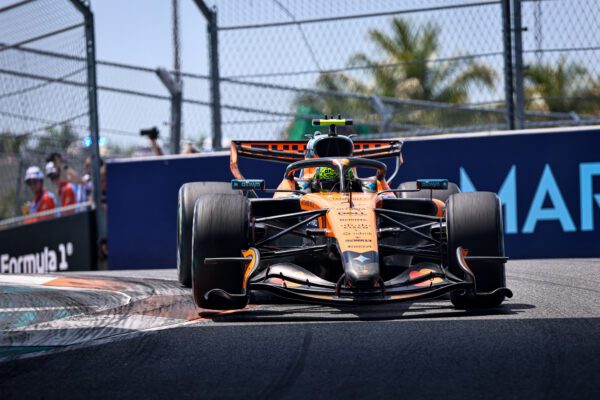





Formula 1 cars are engineered for extreme speeds, agility, and precision on diverse tracks. Aerodynamics stands as the single most important performance discipline in modern Formula 1, influencing a car’s behavior, cornering speed, and top-end performance.
Engineers meticulously design every surface to manipulate airflow, aiming to generate downforce while minimizing drag.
The difference between competitive and uncompetitive cars is often measured in downforce counts, highlighting the continuous aerodynamic arms race in the sport. This intricate balance between downforce and drag is fundamental to understanding contemporary Formula 1 car design.
The front wing’s aerodynamic influence
The front wing serves as the initial point of aerodynamic contact on a Formula 1 car, crucially dictating the airflow behavior for the entire vehicle. It is an intricate and sophisticated design, composed of multiple elements such as endplates, the main plane, flaps, and strakes.
Its primary function is to generate downforce, which is a vertical aerodynamic force that pushes the car downwards onto the track. This downforce significantly boosts cornering speeds and improves overall handling characteristics.
The front wing operates on the principle of inverted airplane wings, creating a low-pressure area beneath the wing and a high-pressure zone above it. These pressure differences are essential for producing the necessary downforce.
Beyond generating this downward force, the endplates and other elements are designed to steer airflow around the front wheels and over the sidepods.
This directed airflow reduces aerodynamic drag and enhances the car’s overall aerodynamic efficiency. The flaps and strakes across the wing also channel airflow towards the car’s underbody and rear diffuser, further increasing downforce and performance.


A well-designed front wing can contribute between 25% to 40% of the car’s total downforce, depending on the setup. Without a front wing, cars lose substantial downforce and can become unstable at high speeds.
The rear wing’s role in stability and speed
The rear wing is a vital component positioned at the upper rear section of an F1 car’s aerodynamic package. It functions on opposite principles to an aircraft wing, with its inverted aerofoil design generating downward pressure, known as downforce, under high-speed airflow.
This downforce firmly pushes the car onto the track surface, increasing tire-to-track contact and traction. This significantly enhances cornering speeds and provides crucial stability, especially under acceleration.
The rear wing typically supplies approximately 30% to 40% of the car’s total downforce, making it the second-largest downforce generator after the underbody diffuser. Its design comprises a mainplane, flaps, guide vanes, endplates, and mounting structures.
The trailing flaps allow for angle-of-attack adjustments, altering the balance between downforce and drag. Vertical endplates manage wingtip vortices and reduce induced drag, which is important for aerodynamic efficiency.
Teams adjust the rear wing’s angle based on the circuit characteristics; steeper angles are used for high-downforce tracks like Monaco, while flatter angles are preferred for low-drag, high-speed circuits such as Monza. This trade-off between downforce for grip and minimal drag for top speed is a constant engineering challenge.
Aerodynamic balance and its impact on handling
Aerodynamic balance describes a state of equilibrium between the downforce generated on the front wheels and that on the rear wheels. This balance is critical for a car’s handling characteristics and driver confidence.
The Centre of Pressure (CofP) is the point where the aerodynamic forces effectively average out, analogous to the aerodynamic equivalent of the longitudinal Centre of Gravity. Adjusting the front and rear downforce levels directly alters this CofP.
An imbalance can lead to significant handling issues; too much aerodynamic pressure at the front causes oversteer, where the front tires lose grip, while excessive downforce at the rear results in understeer, where the front end lacks responsiveness. A typical F1 car aims for approximately 45% of its total downforce to act at the front axle line.
The aerodynamic balance is not static and shifts dynamically during a lap. Under braking, the car pitches forward, moving the front wing closer to the ground and raising the rear, causing the Centre of Pressure to move forward.
This provides strong front grip for turn-in but can make the rear feel light or unstable.
Conversely, under acceleration, the CofP moves rearward. Engineers continuously fine-tune wing settings and other aerodynamic components to achieve the optimal balance for different track conditions, tire wear, and driver preferences.
The evolution of drag reduction systems
From 2011 to 2025, Formula 1 utilized the Drag Reduction System (DRS) as a driver-adjustable bodywork element. DRS involved a movable flap on the rear wing that, when activated, would open to reduce aerodynamic drag.
This reduction in drag led to an increase in straight-line speed, typically providing a gain of 10-12 km/h by the end of an activation zone. The primary purpose of DRS was to promote overtaking by giving the trailing car a temporary speed advantage.
However, DRS activation was conditional, requiring a driver to be within one second of the car ahead at designated detection points on the track. This system aimed to alleviate the “dirty air” effect, where turbulent air from a leading car reduced the aerodynamic performance of a following car.
For the 2026 Formula 1 World Championship, DRS has been replaced by a more comprehensive active aerodynamics system. This new system features movable front and rear wings designed to dynamically adjust throughout a lap.
Drivers now have two primary aerodynamic modes at their disposal: Corner Mode (Z-Mode) and Straight-line Mode (X-Mode). In Corner Mode, the wing elements remain in a high-downforce setting to maintain grip through turns.
In Straight-line Mode, the wings flatten into a low-drag configuration to maximize top speed on straights. Crucially, unlike DRS, the deployment of Straight-line Mode is no longer contingent on proximity to another car, allowing any driver to activate it within designated track zones.
| Aerodynamic Component | Primary Function | Downforce Contribution (Approx.) | Impact on Speed |
|---|---|---|---|
| Front Wing | Generates front downforce, manages airflow to rest of car | 25-40% | Increases cornering speed, reduces drag downstream |
| Rear Wing | Generates rear downforce, provides stability | 30-40% | Increases cornering speed, creates drag on straights |
| Floor & Diffuser | Generates efficient downforce via ground effect | 50-61% | Significant increase in cornering speed with minimal drag penalty |
| DRS (Pre-2026) | Reduces rear wing drag on straights | Temporarily reduced | Increases straight-line speed (10-12 km/h) |
| Active Aero (2026) | Dynamically adjusts front & rear wings for optimal downforce/drag | Variable | Maximizes cornering grip (Z-Mode) and straight-line speed (X-Mode) |
The constant pursuit of aerodynamic efficiency
Aerodynamic efficiency is a critical metric in Formula 1, describing the relationship between the downforce a car generates and the drag it produces. Engineers constantly strive to maximize this ratio, extracting more downforce for each unit of drag penalty.
Every surface on a modern F1 car, from the front wing endplates to the exhaust exit, represents a considered aerodynamic decision. The goal is not merely to maximize downforce or minimize drag in isolation, but to achieve the optimal balance for overall lap time.
Teams tailor their aerodynamic packages, including wing angles, to suit specific circuit layouts. High-downforce circuits like Monaco and Hungary demand larger wing angles for maximum cornering grip, while low-downforce tracks such as Monza require flatter wings to prioritize straight-line speed.
The 2026 regulations, with their focus on active aerodynamics and a flatter floor concept, aim to further enhance aerodynamic efficiency and promote closer racing. These changes are designed to reduce the negative effects of turbulent air, allowing cars to follow more closely without significant loss of grip.
The ongoing development in Formula 1 aerodynamics underscores its pivotal role in performance. Small gains in aerodynamic efficiency can translate into significant lap time advantages over a race distance.