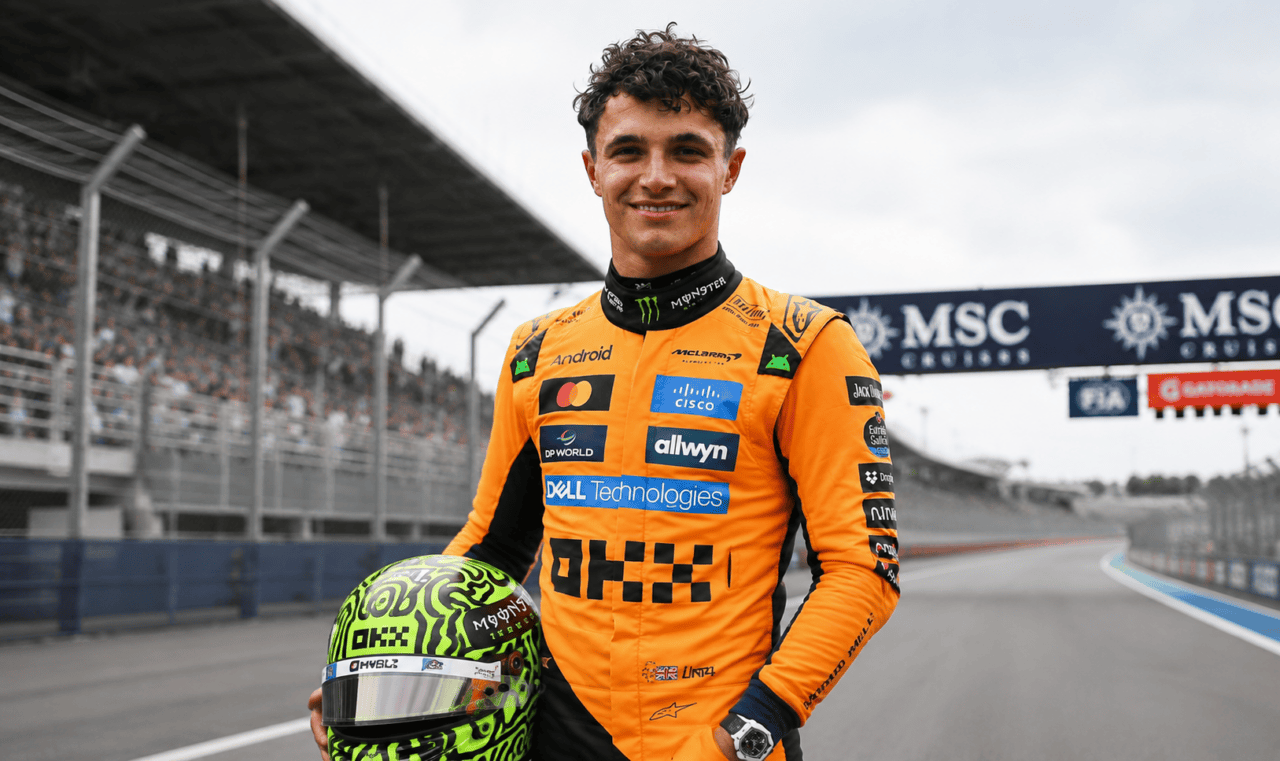
Lando Norris has explained that his early struggles during the Las Vegas Grand Prix were primarily due to difficulties managing his battery deployment. This issue significantly compounded McLaren’s already acknowledged straight-line speed deficit at the circuit.
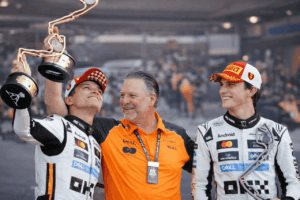
Despite these challenges, Norris ultimately secured a second-place finish, just six tenths behind race winner Max Verstappen. His teammate Oscar Piastri also achieved a podium, giving McLaren a strong double result that helped them gain ground on Red Bull in the Constructors’ Championship battle for third.
Norris had started third after Kimi Antonelli’s grid penalty was applied but had anticipated a tough race. He had previously described McLaren’s straight-line speed as “shocking” after it hindered his qualifying bid for pole position.
The opening stint proved more problematic than expected, with Norris dropping behind Piastri, who started 17th, and falling outside the top 10 at one point. However, the Briton rallied, climbing to sixth place during a mid-race Safety Car period.
The Safety Car was deployed on Lap 19 following a collision between Rafael Camara and Sergio Perez at Turn 14. From that point, Norris remained with the leading pack, capitalising on late-race incidents to secure his podium.
George Russell went straight into the barrier at Turn 5 with three laps remaining, while Kimi Antonelli in the sister Mercedes experienced a brief loss of power on the penultimate tour. These events allowed Norris to climb to second.
Norris reflected on the chaotic nature of the event, stating, “I think that must have been the most chaotic race ever in the history of Formula 1.” He admitted to not knowing what was happening half the time.
“I didn’t know if I was going to have the best race and have a chance to win or end up last. I had everything in this race. I timed things well in terms of getting back to the front. It was also a race of not making mistakes, like a lot of people made. Chaotic, but a fun day, and a good result for us as a team.”
The McLaren driver clarified that his early struggles were due to a shortage of electrical energy at crucial moments, which exacerbated the car’s straight-line speed weakness and left him vulnerable to overtakes.
He acknowledged that the Safety Car helped his recovery, moving him from around P10 to P6, and insisted that the car’s pace was consistently good throughout the race.
“It was just at the very beginning of the race, trying to figure out the battery, and I always just seem to be on the bad side of every time I got overtaken, I had no battery, someone else had more battery behind, and I just kept dropping back,” Norris explained.
He added that managing the battery was a constant focus, saying, “I’m looking at the battery more than I’m looking where I’m going around this track. So it’s the most important thing.”
Norris highlighted the strength of his second half of the race, attributing it to avoiding mistakes and navigating the chaos. He also mentioned playing things right in the final laps regarding positioning, slipstreams, and battery usage.
He concluded that while winning was not an option, P2 was the best possible outcome, and he was happy to have achieved it. Norris also confirmed that tyre compounds were not a factor in his fluctuating performance.
“Yeah, it was nothing to do with tyres,” he reiterated. “The pace was just as good in the first stint as it was in the second.”
The primary challenge was the car’s vulnerability on the straights, which necessitated constant battery management. Norris estimated pressing “nine buttons a lap” to optimise battery usage and give McLaren any chance.
He praised the team’s efforts in relaying information and making improvements during the race, which contributed to their strong finish.