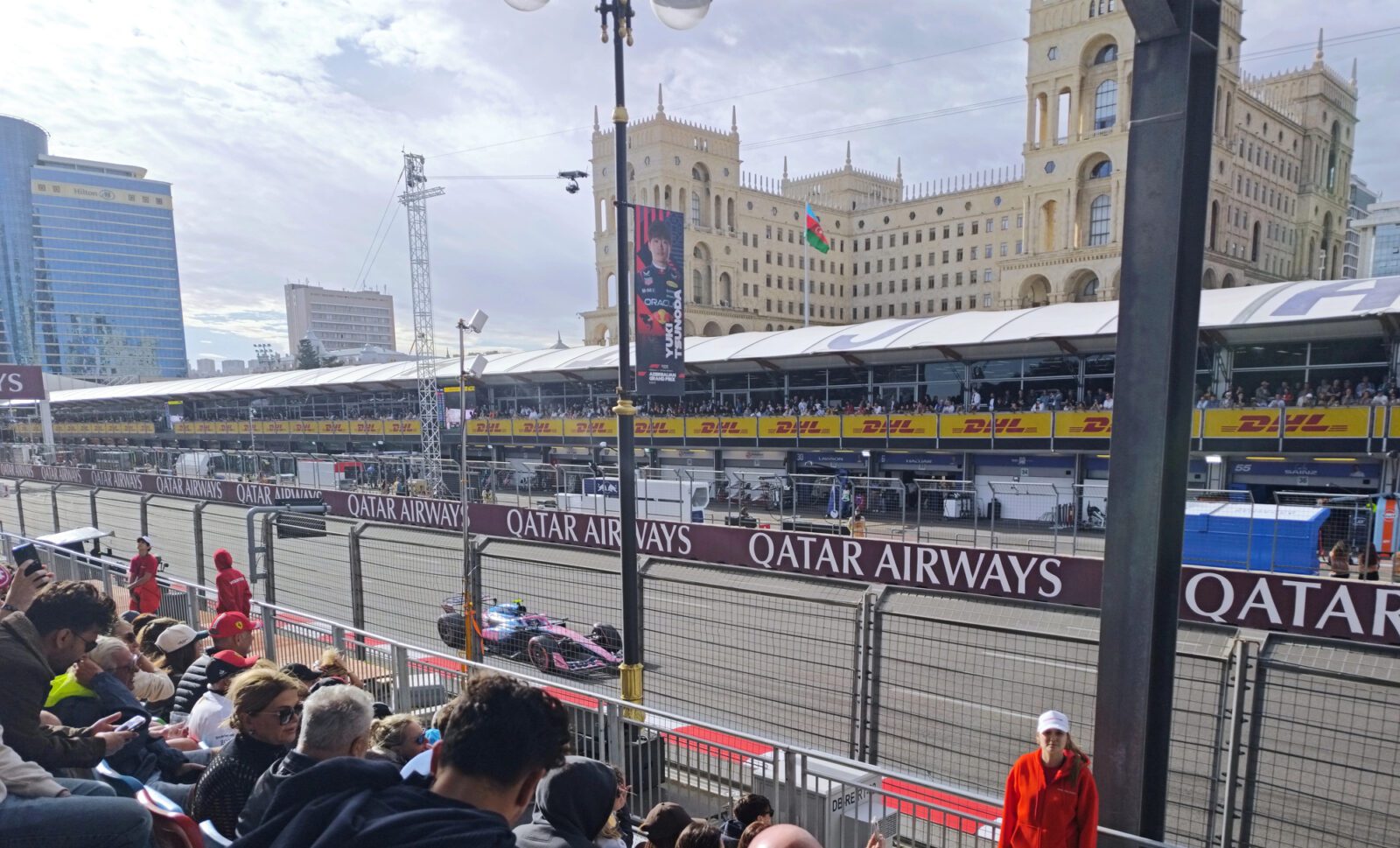
The Baku City Circuit stands as a distinctive and demanding fixture on the Formula 1 calendar, renowned for its dramatic contrasts. This Hermann Tilke-designed street circuit seamlessly blends the modern architecture of Azerbaijan’s capital with its ancient walled Old City.
Making its debut in 2016 as the European Grand Prix, the venue quickly established itself as a source of unpredictable racing. From 2017 onwards, it has been known as the Azerbaijan Grand Prix, consistently delivering high-octane drama.
The baku city circuit: a unique street track
The Baku City Circuit is a temporary street circuit, constructed entirely on public roads that are transformed for race week. Its anti-clockwise layout measures 6.003 kilometres, making it one of the longest street circuits in Formula 1.
This unique characteristic presents a significant challenge for teams and drivers, demanding a delicate balance in car setup. Engineers must compromise between optimising for high-speed sections and ensuring agility through the tight, technical parts of the track.
The circuit’s design incorporates both the expansive boulevards along the Caspian Sea waterfront and the intricate, narrow passages through the historic Old City. This juxtaposition creates a truly one-of-a-kind racing environment.
Grandstands and hospitality facilities are temporarily installed, offering spectators a close-up view of the action against a backdrop of ancient landmarks and contemporary skyscrapers. The temporary nature of the track also means varying grip levels and an uneven surface in places.
Circuit layout and technical challenges
The Baku City Circuit is defined by its two vastly different halves, each presenting distinct technical demands. The first and third sectors feature long, flat-out sections, including the monumental 2.2-kilometre main straight along Neftchilar Avenue.
This straight is the longest on the Formula 1 calendar, allowing cars to reach speeds exceeding 340 km/h and creating significant slipstreaming opportunities. Valtteri Bottas famously recorded a top speed of 378 km/h during qualifying in 2016.


In stark contrast, the second sector winds through the UNESCO World Heritage-listed Old City, featuring a narrow uphill section past the Maiden Tower and the castle walls. At its tightest point, around Turns 8 and 9, the track is just 7.6 metres wide.
This incredibly confined section leaves absolutely no room for error, with unforgiving concrete barriers lining the circuit. Drivers must demonstrate extreme precision and nerve to navigate these twists without incident.
The circuit features a total of 20 corners and an elevation change of 28 metres, adding to its complexity. The combination of high-speed blasts and intricate, low-speed corners makes finding the optimal car setup a constant engineering puzzle.
Key sections and overtaking opportunities
Overtaking at the Baku City Circuit is often facilitated by the immense main straight and the heavy braking zone into Turn 1. This 90-degree left-hander provides a prime opportunity for drivers to make a move after slipstreaming.
Under the 2026 Formula 1 regulations, the circuit incorporates new active aerodynamic systems to enhance racing. There are two designated Straight Mode zones where cars can reduce drag for maximum speed.
The first Straight Mode zone is located on the acceleration section between Turns 2 and 3. The second, and most significant, covers the entire main straight from the exit of Turn 20 down to Turn 1.
Additionally, the Overtake Mode system is available to drivers within one second of the car ahead. Its detection point is positioned shortly after Turn 16, with activation occurring before Turn 17.
This strategic placement allows drivers to carry an electrical deployment advantage through the final flat-out sequence, combining it with Straight Mode and slipstream for a powerful attack into Turn 1. The circuit also features several other 90-degree corners in the first sector and a high-speed Turn 13.
Azerbaijan Grand Prix: a history of drama
The Azerbaijan Grand Prix has earned a reputation for delivering some of the most thrilling and unpredictable races in recent Formula 1 history. Its unforgiving nature often leads to safety cars, red flags, and unexpected outcomes.
The 2017 race saw Daniel Ricciardo clinch victory from tenth on the grid amidst multiple safety car periods and a red flag, which also featured a notable clash between Lewis Hamilton and Sebastian Vettel. Lance Stroll secured a surprise rookie podium in that chaotic event.
Max Verstappen experienced heartbreak in 2021 when a tyre failure denied him a likely victory just laps from the finish. His teammate, Sergio Pérez, capitalised to take his first Baku win, while Lewis Hamilton famously overshot Turn 1 after a restart due to an accidental ‘brake magic’ activation.
Sergio Pérez has since cemented his status as the “King of Baku,” securing multiple victories in 2021 and 2023, and achieving five podium finishes at the circuit. Charles Leclerc, despite holding the pole position record with four consecutive poles from 2021 to 2024, is yet to win a Grand Prix in Baku.
Recent editions have continued the trend of dramatic racing. Oscar Piastri took victory in 2024, while Max Verstappen won the 2025 event, which saw a record-breaking six red flags during qualifying.
George Russell claimed the win in the 2026 Azerbaijan Grand Prix.
Circuit specifications and records
| Specification | Detail |
|---|---|
| Circuit Length | 6.003 km |
| Number of Turns | 20 |
| Race Laps | 51 |
| Race Distance | 306.049 km |
| Race Lap Record | 1:43.009 (Charles Leclerc, Ferrari, 2019) |
| Pole Position Record | 1:40.203 (Charles Leclerc, Ferrari, 2023) |
| Highest Recorded Speed | 378 km/h (Valtteri Bottas, 2016 qualifying) |
| Longest Straight | 2.2 km |
| Narrowest Point | 7.6 metres |
The Baku City Circuit’s contract to host the Formula 1 Azerbaijan Grand Prix is currently extended until at least 2030. This ensures that this thrilling and challenging street circuit will continue to provide memorable moments for years to come.