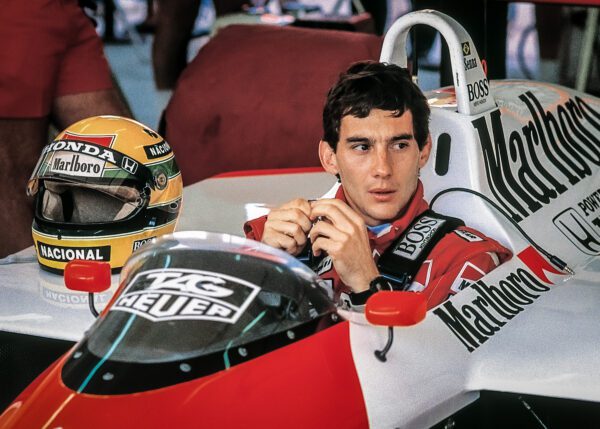


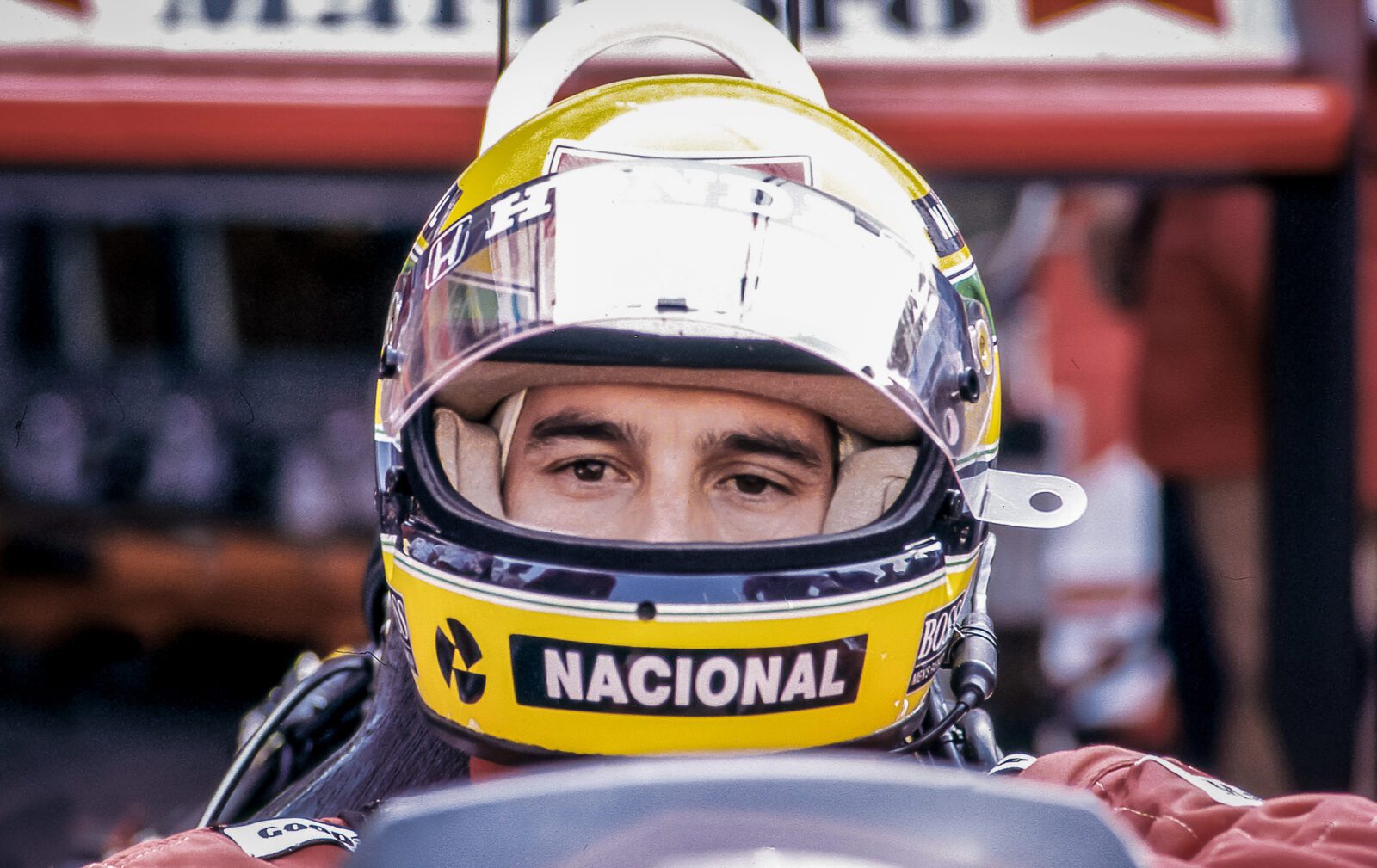
Ayrton Senna da Silva, born on March 21, 1960, in São Paulo, Brazil, remains one of Formula 1’s most revered figures. His career, spanning from 1984 to 1994, was marked by extraordinary talent, fierce determination, and a relentless pursuit of perfection.
Senna achieved three Formula 1 World Drivers’ Championships, 41 Grand Prix victories, and 65 pole positions during his time in the sport.
He is widely celebrated for his raw speed, uncompromising driving style, and particularly his exceptional performances in wet conditions. Senna’s impact extended beyond the racetrack, as he was also known for his philanthropy and deep connection to his home country of Brazil.
Early beginnings and junior racing success
Senna’s motorsport journey began at the age of 13 in karting, where his father built his first go-kart using a lawnmower engine. He quickly demonstrated natural talent, winning the South American Kart Championship in 1977.
He was a runner-up twice in the Karting World Championship in 1979 and 1980, showcasing his potential for future greatness. In 1981, Senna moved to England to pursue a career in open-wheel racing, initially competing in Formula Ford 1600.
He dominated the British and Townsend Thoresen Formula Ford 1600 Championships in his debut year. Senna then progressed to Formula Ford 2000, winning both the British and European championships in 1982.
His ascent continued in 1983 when he won the prestigious British Formula 3 Championship after a close battle with Martin Brundle. That same year, he also triumphed at the inaugural Macau Formula 3 Grand Prix, solidifying his reputation as a rising star.
Formula 1 debut and rise with toleman and lotus
Ayrton Senna made his Formula 1 debut at the 1984 Brazilian Grand Prix with the Toleman team. Despite driving an uncompetitive car, he immediately caught attention with his remarkable performances.


His breakthrough moment came at the rain-soaked 1984 Monaco Grand Prix, where he charged from 13th on the grid to finish second before the race was stopped early. This performance highlighted his extraordinary wet-weather driving skills.
For the 1985 season, Senna moved to the Lotus team, where he secured his first Formula 1 pole position and victory at the Portuguese Grand Prix in torrential rain. He finished over a minute ahead of the second-placed driver, Michele Alboreto.
During his three seasons with Lotus from 1985 to 1987, Senna achieved six Grand Prix wins and 16 pole positions. He consistently demonstrated his speed and ability to extract maximum performance from his machinery.
McLaren dominance and the prost rivalry
Senna’s career reached new heights when he joined McLaren in 1988, partnering with two-time world champion Alain Prost. Their partnership formed one of the most dominant and intense rivalries in Formula 1 history.
In 1988, driving the Honda-powered McLaren MP4/4, Senna won his first World Championship, securing eight victories to Prost’s seven. The team won 15 of the 16 Grands Prix that season, a sign of their combined prowess and the car’s dominance.
The rivalry between Senna and Prost escalated, leading to title-deciding collisions at the Suzuka circuit in both 1989 and 1990. Prost won the 1989 title, while Senna claimed his second championship in 1990.
Senna secured his third and final World Championship in 1991, taking seven victories, including an emotional home Grand Prix win in Brazil. His qualifying performance at the 1988 Monaco Grand Prix, where he out-qualified Prost by 1.4 seconds, is often cited as one of the greatest qualifying laps ever.
Even in his final year with McLaren in 1993, driving an underpowered car, Senna achieved five victories, including a memorable win at the European Grand Prix at Donington Park in wet conditions. His last Grand Prix victory came at the 1993 Australian Grand Prix, where he shared the podium with Prost in a moment of reconciliation.
Williams and tragic end
For the 1994 season, Ayrton Senna moved to the Williams team, replacing the retired Alain Prost. He partnered with Damon Hill, driving the Williams FW16.
Tragically, on May 1, 1994, during the San Marino Grand Prix at the Imola Circuit in Italy, Senna was killed in a crash while leading the race. His car, the Williams FW16, inexplicably left the track at the Tamburello corner and struck a concrete barrier.
The incident followed a dark weekend for Formula 1, as Austrian driver Roland Ratzenberger had also died in a separate crash during qualifying the day before. Senna’s death led to significant safety reforms in motorsport.
Legacy and enduring impact
Ayrton Senna’s legacy extends far beyond his impressive statistics and on-track achievements. He is remembered for his intense focus, spiritual approach to racing, and magnetic charisma.
His iconic yellow helmet, adorned with green and blue stripes, remains one of the most recognizable in motorsport history. Senna’s reputation as the ‘Rain Master’ stemmed from his unparalleled ability to perform in challenging wet conditions.
Off the track, Senna was a philanthropist who quietly donated millions and co-founded a foundation to combat child poverty just weeks before his passing. This foundation became the Instituto Ayrton Senna, which has since supported millions of children in Brazil.
His state funeral in São Paulo was attended by an estimated three million people, a sign of his status as a national hero in Brazil. Senna’s influence continues to inspire generations of drivers and fans worldwide.
| category | statistic |
|---|---|
| active years | 1984–1994 |
| teams | toleman, lotus, mclaren, williams |
| entries | 162 |
| starts | 161 |
| championships | 3 (1988, 1990, 1991) |
| wins | 41 |
| podiums | 80 |
| pole positions | 65 |
| fastest laps | 19 |