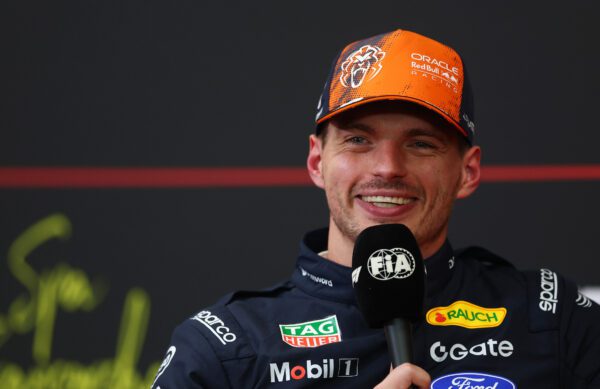




Max Verstappen will start the 2026 São Paulo Grand Prix from the back of the grid. The Red Bull driver incurred a 30-place power unit penalty ahead of Sunday’s race at the Autódromo José Carlos Pace. Verstappen expressed a preference for multiple Safety Car periods during the event. He believes this would compact the field and prevent leading cars from establishing a significant advantage.
The penalty stems from Red Bull introducing a fifth Internal Combustion Engine (ICE), a fifth turbocharger, and a fifth exhaust set to Verstappen’s car. Under the 2026 Formula 1 Sporting Regulations, exceeding the season allocation of four units for each of these components results in a 10-place grid penalty per component.
This cumulative 30-place grid drop mandates a back-of-the-grid start, irrespective of his qualifying performance. Red Bull made the decision to fit the new power unit after Verstappen reported issues with engine braking and clutch during Friday’s practice sessions at Interlagos. The team assessed the risk of continuing with the existing unit as too high.
Verstappen was not the only driver to receive grid penalties for the São Paulo Grand Prix. Lewis Hamilton (Ferrari) also faces a back-of-the-grid start following a complete power unit replacement after issues in Free Practice 3. Charles Leclerc (Ferrari) received a 10-place penalty for a fifth ICE. George Russell (Mercedes) has a five-place penalty, and Sergio Pérez (Cadillac) will also start from the back.
Qualifying for the 2026 São Paulo Grand Prix was significantly affected by rain. Lando Norris secured pole position for McLaren with a lap time of 1:27.470. George Russell initially qualified second but will drop to seventh due to his five-place grid penalty. Andrea Kimi Antonelli (Mercedes) qualified third and will move up to the front row alongside Norris.
Liam Lawson (Racing Bulls) is set to start third, with Nico Hülkenberg (Audi) lining up fourth, benefiting from the penalties applied to Russell and Leclerc. Verstappen did not participate in Q2, as his back-of-the-grid start was already confirmed prior to the session.
The Autódromo José Carlos Pace, known as Interlagos, is a 4.309-kilometre circuit featuring 15 corners and notable elevation changes. It is generally considered a track that offers good overtaking opportunities, particularly at the Senna S and Turn 4.
However, Verstappen noted that the 2026 regulations, which include ‘Straight Mode’ for drag reduction and ‘Overtake Mode’ for additional electrical power, might make passing more challenging than in previous years. The circuit’s altitude, at 765 metres, also reduces air density, though less severely than in Mexico City.


Interlagos is also known for its unpredictable weather, with conditions capable of changing rapidly. Pirelli has supplied its softest compounds (C3, C4, C5) for the weekend, one step softer than in 2025, anticipating significant tyre degradation. The probability of Safety Car deployments during the race is estimated at 80%.
Red Bull is competing in 2026 with its own Ford-branded power unit for the first time. The team currently holds third position in the constructors’ championship. Verstappen has secured three victories this season, at Bahrain, Singapore, and Mexico City.
Verstappen has a history of strong recovery drives at Interlagos, having won the 2024 Grand Prix after starting 17th. In 2025, he finished third after beginning the race from the pit lane.
Regarding his current situation, Verstappen stated that qualifying held little significance for him given the confirmed back-of-the-grid start. He acknowledged the ‘fun’ aspect of previous comeback drives but expressed a desire not to repeat the scenario annually.