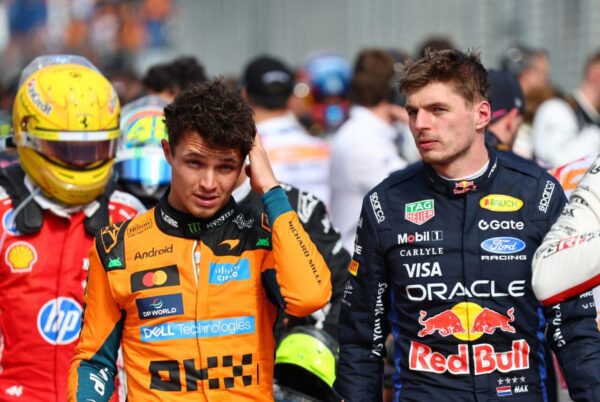





Lando Norris has expressed reservations about McLaren’s championship prospects, despite securing back-to-back victories at the Hungarian and Dutch Grands Prix. The reigning champion indicated that his current form might be a temporary illusion, suggesting the car lacks the consistent performance required for a sustained title challenge.
Following the Dutch Grand Prix on Sunday, August 23, 2026, Kimi Antonelli maintains a significant lead in the 2026 Formula 1 Drivers’ Championship with 242 points. Mercedes teammate George Russell and Ferrari’s Lewis Hamilton are tied for second, both on 183 points, with Russell ahead on countback due to more wins. Norris sits fourth in the standings with 159 points, having reduced his deficit to Antonelli to 83 points after his recent successes.
Norris’s caution stems from identified weaknesses in the McLaren MCL39. He specifically highlighted the car’s struggles in low-speed cornering and its relatively high aerodynamic drag. These issues were evident at Circuit Zandvoort, where Norris noted the car’s strong performance in high-speed sections but a clear deficit in tighter, twistier parts of the track.
McLaren team principal Andrea Stella has acknowledged these performance gaps, attributing approximately 70% of the deficit to cornering performance and 30% to straight-line speed. Data from earlier in the season showed Norris was 11 km/h slower than Antonelli on the run to Copse at Silverstone and 9 km/h slower than Russell to Turn 4 in Austria.
Further compounding McLaren’s challenges is an admitted design miscalculation for the 2026 car. The team confirmed that the MCL39’s wheelbase is too short, which will limit its aerodynamic development potential until the 2027 season. This design choice has reportedly put McLaren approximately three months behind its main rivals in terms of development pace.
The upcoming Italian Grand Prix at Monza, scheduled for two weeks’ time, presents a significant test for McLaren’s current car. The Autodromo Nazionale Monza is renowned as the ‘Temple of Speed,’ characterized by its long straights and heavy braking chicanes.
Monza’s 5.793 km layout demands a low-downforce aerodynamic setup to minimize drag and maximize straight-line speed, a configuration that directly exposes McLaren’s known weaknesses. The circuit features a high full-throttle percentage, typically between 67-70%, and requires heavy braking into chicanes like the Variante del Rettifilo, where speeds drop from over 370 km/h to 70-80 km/h.
Meanwhile, Mercedes team principal Toto Wolff has outlined a strategic approach to upgrades, citing budget cap limitations. Wolff stated that Mercedes cannot match the aggressive development pace of rivals like Ferrari and McLaren, who have introduced more new components this season.
Mercedes has brought 24 new components to its car in 2026, significantly fewer than Ferrari’s 40 and the 38 introduced by both Red Bull and McLaren. Wolff emphasized that the team must be ‘strategic’ about when to deploy upgrades to achieve the greatest impact on performance, operating within the $215 million cost cap for the current season.
Wolff also acknowledged the threat posed by McLaren’s recent performance, noting that both the Hungarian and Dutch Grands Prix have historically been strong circuits for the Woking-based team. He indicated that the championship battle could tighten, with Hamilton also a factor despite his current points deficit.