



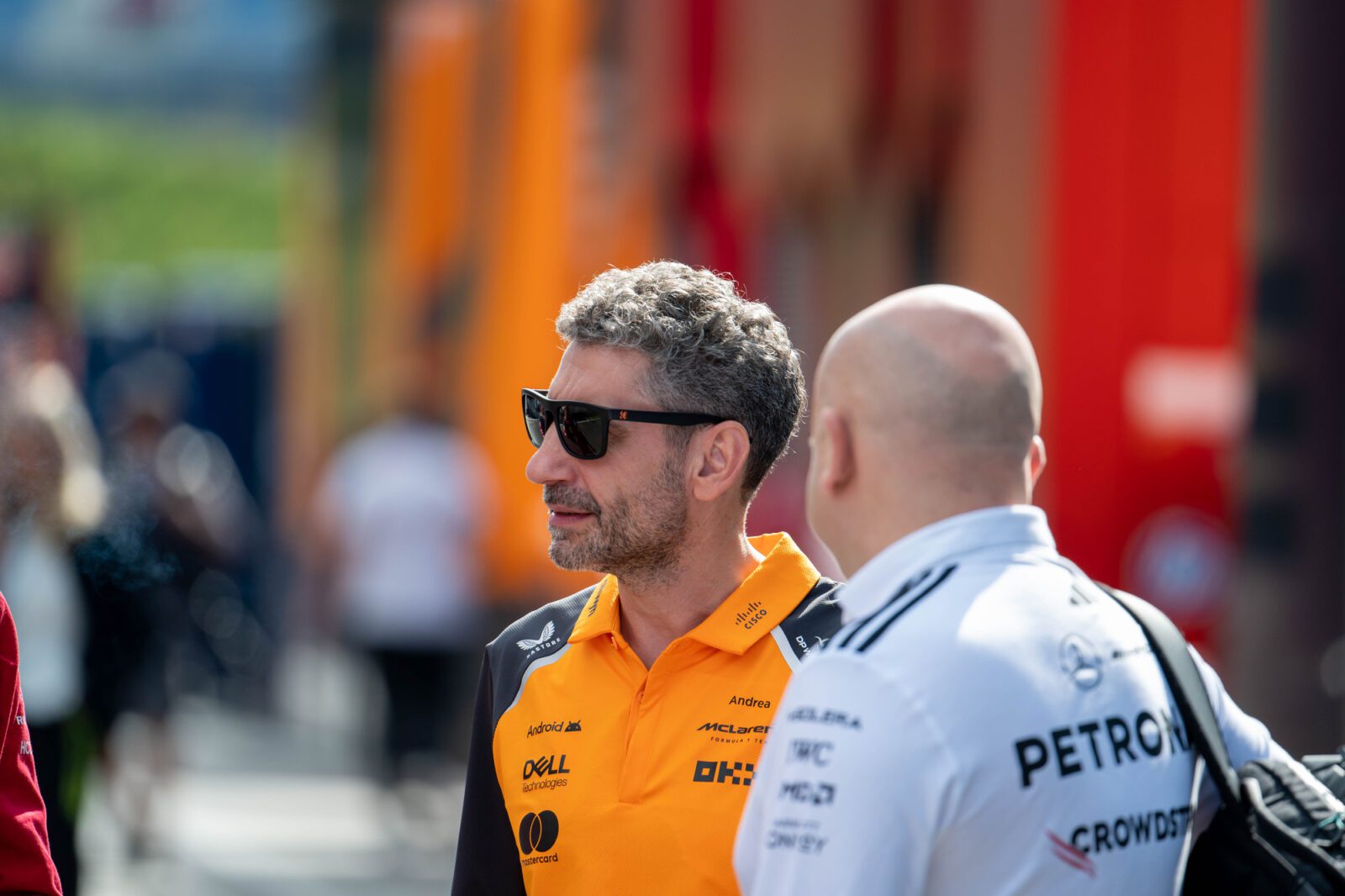
McLaren has formally approved its experimental ‘rotating rear wing’ for deployment in forthcoming Formula 1 races. The confirmation follows successful track evaluations conducted during Friday practice sessions at the Hungarian Grand Prix. Team principal Andrea Stella stated the design passed both mechanical and aerodynamic assessments.
Despite the positive outcome, McLaren opted against racing the new rear wing at the Hungaroring. The team’s decision aligns with a cautious approach to introducing complex aerodynamic solutions. This development marks McLaren as the third team to implement such a design.
Ferrari pioneered the active aerodynamic concept, often referred to as the ‘Macarena wing’, during pre-season testing. Their design inverts the upper flap in straight-line mode, generating a small amount of lift to reduce drag and improve aerodynamic efficiency. Lewis Hamilton first ran Ferrari’s version in practice at the Chinese Grand Prix before its competitive debut in Barcelona.
Red Bull also introduced its own iteration of the rotating wing. However, the design was temporarily withdrawn after two high-speed incidents involving Max Verstappen at the Austrian and British Grands Prix. Verstappen described the failures as ‘super dangerous’.
Red Bull technical director Pierre Waché later confirmed that the team had identified and fixed a mechanical problem with their rear wing. The issue stemmed from airflow reattachment when the wing transitioned from straight-line to cornering mode. Red Bull reverted to a previous-spec wing for the Belgian Grand Prix.
McLaren’s rotating wing concept rolls forward, a mechanism similar to the approach taken by Red Bull. Andrea Stella acknowledged the project’s complexity, particularly concerning the management of aerodynamic flow reattachment during actuation, which is governed by FIA regulations.
Stella indicated that the data collected during the Budapest track sessions validated the team’s pre-event simulations. This consistency allowed for the formal sign-off of the design. McLaren had previously attempted to test a lower-drag version at the Austrian Grand Prix, but it was withdrawn due to early problems.
The team’s new state-of-the-art wind tunnel, opened ahead of the 2024 F1 season, supported the development. However, Stella clarified that the wind tunnel was not the primary factor in determining aerodynamic reattachment behaviour. He stressed the importance of track observation for such delicate projects.
Ferrari, meanwhile, introduced a third version of its Macarena rear wing at the Hungarian Grand Prix. This updated SF-26 component incorporated a triple deflector, mirroring a solution McLaren used in Monaco to increase downforce. Ferrari’s design also drew inspiration from Mercedes and Red Bull.
The 2026 Formula 1 regulations mandate active aerodynamics, featuring movable front and rear wings. These systems include ‘Straight Mode’ for low drag on straights and ‘Corner Mode’ for maintaining downforce. An ‘Overtake Mode’ has also replaced the Drag Reduction System (DRS).
Given the efficiency gains offered on straights, high-speed circuits are prime targets for McLaren’s race debut of the device. Potential venues on the 2026 calendar include Monza in September and Baku later that month.
McLaren, as the reigning Constructors’ Champions from 2025, operates with reduced wind tunnel time in 2026. Despite this, Stella confirmed the team is in a comfortable financial position to continue investing in the MCL40’s development.